
Table of Contents
Since Europeans made Mount Kilimanjaro rarity and unique travel destination in the middle of the nineteenth century, the ice-capped, dormant volcano has exercised an unstoppable allure. Africa’s highest mountain, Kilimanjaro is also the tallest free-standing massif in the world and one of the biggest volcanoes, rising nearly 5 km from the nearby plains to a summit of 5892 m. Kilimanjaro is a national park and a World Heritage Site since 1989. It spans 3885 square kilometers. It is also an extraordinarily stunning peak, both up close and from a distance, and it could easily fill a whole mountain.
How Mount Kilimanjaro was Formed?
Approximately 3 million years ago, the Great Rift Valley underwent its most recent eruption, which also generated Mount Meru and Mount Kenya. The three major peaks of Kilimanjaro are surrounded by craters and overhanging volcanic peaks. The characteristic snow-capped crown of Kibo, the youngest and tallest mountain, is really a huge crater that was created around 460,000 years ago during the most recent era of intense volcanic activity. Uhuru Peak, the summit, is 5895 meters high.
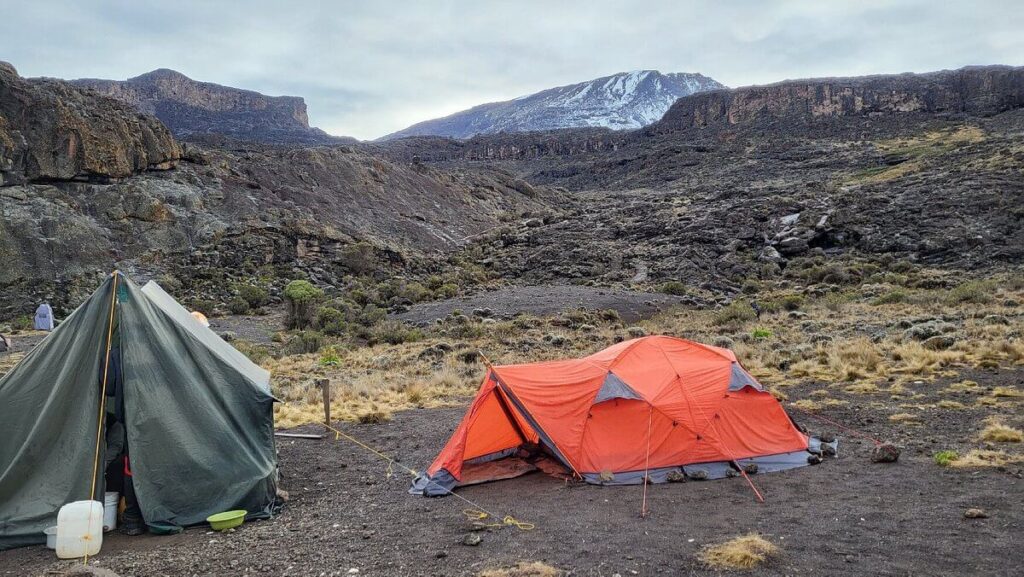
All that’s left of a massive volcano that lost its eastern edge in a large explosion is the ragged, pimple-like Mawenzi, which lies 11 km to the east of Kibo (and is attached to it by a wide lava ridge); its highest point is Hans Meyer Peak (5149m). On the mountain’s western flank, the Shira Ridge is the oldest summit. For many travelers, the idea of climbing the mountain, which may take anywhere between five and eight days, is both thrilling and intimidating.
Kilimanjaro has developed somewhat of an easy image due to the fact that no technical climbing abilities are necessary to reach the summit (it is claimed to be the world’s highest non-technical climb); this is a hazardous notion that you should disregard.
What is the origin of the name Mount Kilimanjaro?
The name of the mountain has an unclear etymology. It was the “mountain of glory” or the “mountain of caravans” to some explorers, who understood it to imply “something which cannot be conquered.” Mlima denotes a mountain, whereas Kilima denotes a hill in both Kiswahili and Kichagga (the language of the Chagga tribe at the foothills of the mountain). Even though Chagga places names and names in the vicinity of Mount Kenya frequently begin with ki, the usage of the diminutive may be intended to be loving.
The meaning of the second part of the name is still unknown; it might be connected to a Kichagga term for caravan, a remnant of the slave, or the ancient word “kyaro” for God. Kilimanjaro, of course, being the source of life for numerous of these — has a different connotation.
What to Know about Western History of Mount Kilimanjaro?
Since Chinese seafarers described an inland “huge mountain” in the thirteenth century, Kilimanjaro has been known to people outside of Africa. But it wasn’t until 1848 that the German missionary Johannes Rebmann traveled north to try his luck elsewhere after giving up on trying to convert coastal tribes to Christianity. It wasn’t until 1861, when Dr. Otto Kersten and Baron Karl Klaus von der Decken mounted Kilimanjaro to a height of around 4300m, that his description of a snow-capped peak three degrees south of the Equator was acknowledged by organizations like the Royal Geographical Society.
Know the Uniqueness of Guides and Porters on Mount Kilimanjaro
All hikers are required to register with a licensed organization. Kilimanjaro ASAP will supply you with porters and guides to assist you in climbing the peak. All groups must have a licensed guide accompany them, one licensed guide for every two trekkers, according to KINAPA (Kilimanjaro National Park).
The majority of our guides are excellent; many have successfully scaled the mountain several times, and they frequently speak English while other foreign languages guides can be arranged if requested in advance. In spite of this, you may meet your guide ahead of time to see how you get along. After all, he will be your companion for the next week, and you are entrusting him with your life.
Additionally, At Kilimanjaro ASAP we will supply you with porters; typically, each trekker will receive three to four. Porters are only allowed to carry a total of 15 kg apiece, plus 5 kg of their own equipment and in total will be 20kg. In addition, porters do not travel to the summit; however, some will accompany you to the Crater Campground if you have reserved a night there. Instead, they stay at the last hut (Kibo Hut) or campsite (Barafu Campsite) and will re-join you on the descent. The porters still have one of the toughest tasks on the mountain, despite our efforts to control the amount they carry.
Going with small businesses allows you to have a thorough look at how they handle their workers and, if necessary, to voice any concerns to the owner of the business, which is an excellent method to locate respectable businesses. You can identify small businesses online that have a track record of treating their porters properly and giving them a fair wage. Larger firms that have been in business for a while already know how to take advantage of porters. They pay for online advertisements that seem to be ethical, but the fact is that you will never know for sure.
Last but not least, your team should include a cook. You’ll be shocked at how well they can rustle up some really delectable cuisine when on a high-altitude mountain.
The Incredible Summit of Mount Kilimanjaro Uhuru Peak
Many individuals did not reach Uhuru Peak every year due to the high altitude and potential for a speedy ascent, generally as a result of severe mountain sickness. In addition, nearly everyone has excruciating headaches and complete tiredness on summit day, therefore only roughly two-thirds of the forty thousand climbers who undertake the trip each year succeed in reaching Uhuru Peak.
After all of that, there’s no reason why you shouldn’t be able to succeed if you take your time and pay attention to your body’s demands. The mountain also provides plenty of less challenging options for those for whom the idea of reaching the summit seems like a little too much difficult: a hike on the lower elevations, through tropical forest, and onto the edge of sub-alpine moorland, requires no extreme physical preparation and can be completed in a single day.
Western nations claim that the German explorer Hans Meyer and the Austrian climber Ludwig Purtscheller were the first Europeans to scale Kibo on October 6, 1889, and Mawenzi’s ascended in 1912. Although we were told that our forefathers in the Chagga land used to climb both peaks and consecrate their offerings, the legend dates back to the children of Israel who came from Egyptian bondages.
The Myth About Kilimanjaro Ice Cap Meltdown
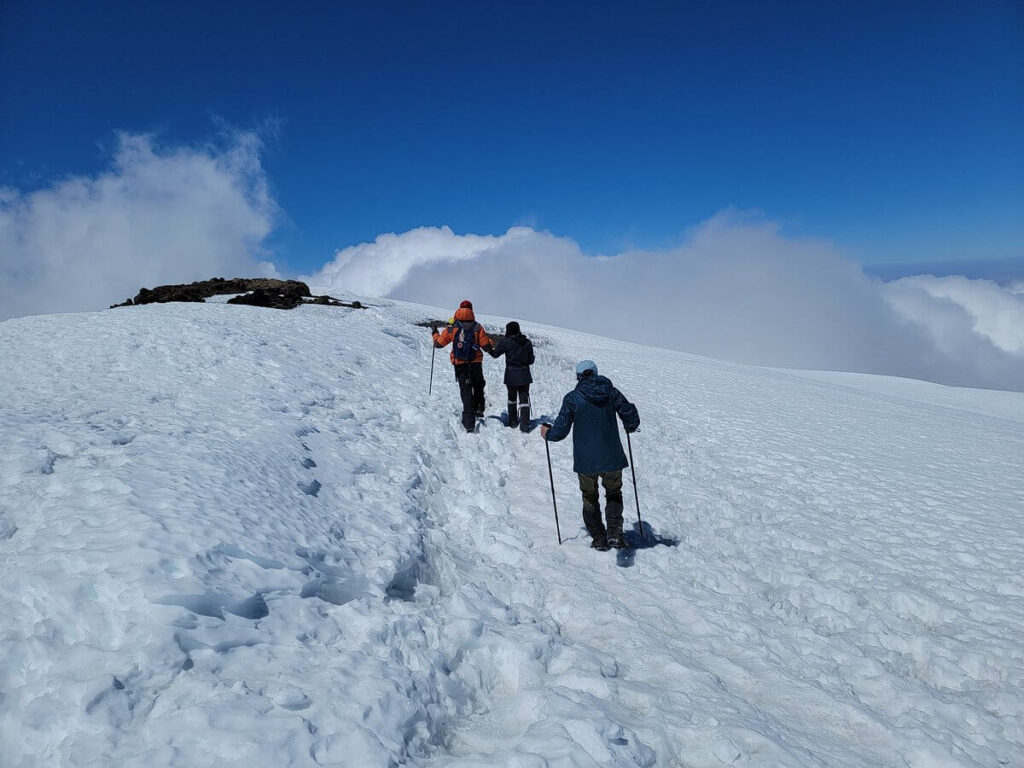
Even though it might seem unbelievable, Kibo’s recognizable white hat will never disappear. Even though they claim back in days that ”Kilimanjaro is becoming hotter, its glaciers and ice cap are melting quickly” and they add over twelve square kilometers of the ice cap were covered in 1912 that it will declined by a full third during the preceding fifteen years, to a size of barely two square kilometers by 2005 but now is 2025 to 2026 and still the glaciers are still there and we have never seen something decrease rather it keep increasing day by day.
Another false news is that Research employing ice cap core samples from Mount Kilimanjaro as a weather archive claim they saw alarmingly shown that the main culprit is global warming (the word itself is a myth). But all who climbed it before may testify of these as well as how forest cover on the mountain’s lower slopes has also been largely protected by park and forest administration.
Prior to 2022, some researchers predicted that the ice cap would have completely vanished between 2014 and 2021, while others offered the more optimistic prediction that the glaciers would finally disappear in 2030. However, as of 2025, there are no signs of the glaciers vanishing, and they are even growing thanks to good park management and the custom of those living near the mountain’s foothills not to cut down trees and behave like their forefathers.
The Difference Between Mount Kilimanjaro Routes
On Kilimanjaro, there are seven primary ascent routes. The Mweka or Marangu trails in the south are typically used for descent. All other routes involve camping, typically at well-known campgrounds furnished with long drops and not much more. Overnights on the Marangu route are spent in a chain of quite decent A-shaped huts. Only rangers are allowed in the “uniport” cottages along these routes.
The fastest, steepest, and the most well-traveled path up is by Marangu, which is approached from the southeast (and down). Even though the trip is typically five days long, adding a sixth day greatly improves your chances of success. The second most common route is from the southwest to Machame, which takes at least six days and is advised to take seven. Although there are occasionally quite steep sections, it is slower and more leisurely than the Marangu, includes campsites rather than cottages, and has a more diversified landscape.
The Lemosho path, which used to be considerably less traveled but is now the favorite route up to Uhuru Peak because of its magnificent landscape and outstanding views, is the main primary route now. The longest path on the mountain often takes eight days to complete but also from 6 and 7 days can be completed. Other routes include the northeastern Rongai path, which is becoming more and more popular, and the short, picturesque, but steep Umbwe route from the south. When you are prepared to climb Mount Kilimanjaro, Kilimanjaro ASAP can plan both routes.
Learn About Mount Kilimanjaro Vegetation Zones
Kilimanjaro is divided into a number of unique habitat zones based on elevation. Farmland disappears and trees take control of over 1800 meters. Most of the forest is secondary growth up to around 2000 meters, but above this point, there is a thick primary cloud forest, which has over 1800 kinds of blooming plants.
Three primate species live in the forest’s lower levels, which are dominated by ferns, podocarpus, and camphor trees. They include the western black-and-white colobus, the bushbaby, and the blue monkey (galago). Mountain reedbuck are also found here, though it’s quite rare that you’ll see one.
Since rainfall is lighter at higher elevations, the forest loses density starting at around 2400 meters. The strange afro-alpine moorland, also known as upland grassland, and the land of the giants, including giant heather, giant groundsel (or tree senecio), and giant lobelia, begin at the tree line (2800–3000 m). The enormous groundsel, which can have a sheaf of yellow blooms, comes in two different forms: the cabbages on stumps and the bigger candelabra-like “trees.” The gigantic groundsel prefers wet, protected areas like stream banks; although they grow slowly, they can live up to 200 years, which is quite long for such weedy-looking veggies.
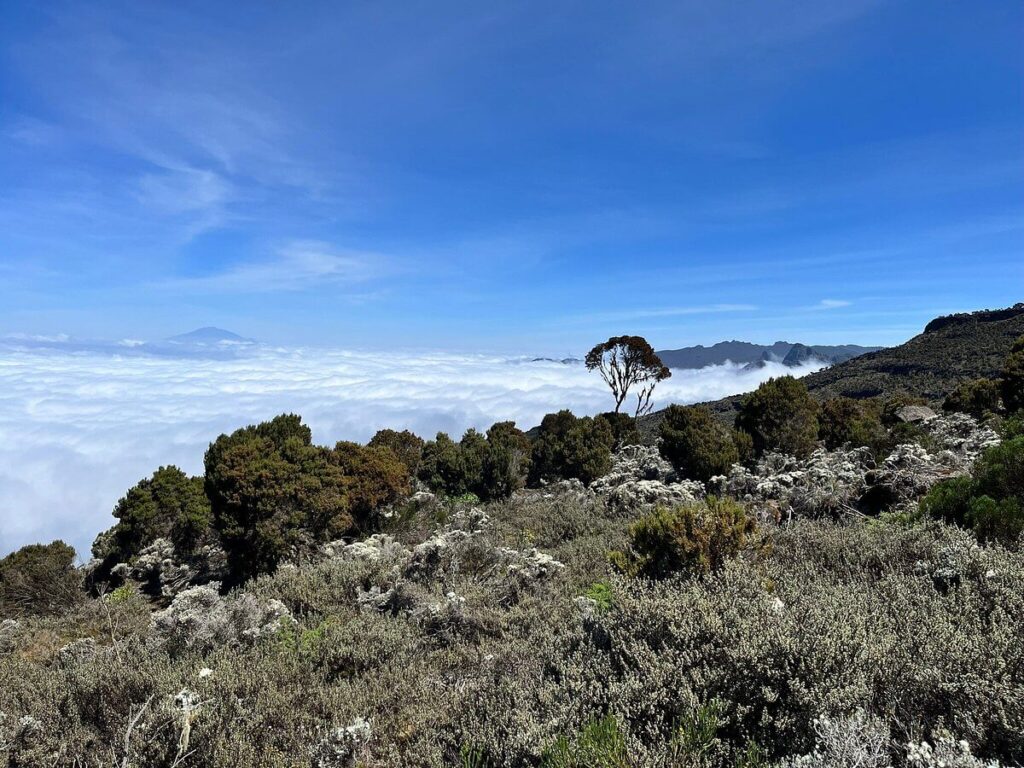
Groundsel and another unusual plant, the tall and fluffy gigantic lobelia, may be found in the alpine bogs further up; the lobelia’s animal-like furriness protects the fragile blossoms. The majority of animals that routinely cross from the forest into the moorland zone are eland and grey duiker, whereas buffalo, bushbuck, and red duiker are less prevalent. The white-necked raven, which is frequently spotted at campsites, is the most prevalent of the few birds.
The desolate alpine desert zone begins above 4600 meters. Few plants can live in these sub-zero temperatures other than mosses and lichens, yet the daisy-like Helichrysum new has been spotted on Kibo’s summit caldera at 5760m next to a fumarole. Even weirder was the unidentified leopard that appeared in Ernest Hemingway’s The Snows of Kilimanjaro and whose frozen remains were discovered near to the peak in 1926. Nobody is aware of its activities thus high up the mountain.
Conclusion
The major peaks of Kilimanjaro, Kibo and Mawenzi, according to the Chagga, were created by two sisters. The older and wiser of the two, Kibo took care to prepare food for difficult times. Mawenzi, however, had no such concerns about the future and developed the habit of turning to Kibo for assistance whenever things became tough. Mawenzi’s ragged and shattered appearance is the result of Kibo hitting her sister on the head with a spoon after she grew frustrated with her sister’s pleading. According to a different Chagga tradition, the mountain has a valuable treasure that is guarded by strong spirits who punish anybody foolish enough to attempt to climb it. The very real modern manifestations of such spirits include acute cold, weariness, and altitude sickness.
Frequently Asked Questions
Why is Mount Kilimanjaro considered unique among mountains?
Mount Kilimanjaro stands out because it is the tallest free, standing mountain in the world. Unlike many famous peaks, it isn’t part of a mountain range, it rises dramatically on its own from the plains. This gives it a striking, almost surreal appearance that you can spot from miles away. It also means you experience a full mountain ecosystem in one place. That combination makes it truly one of a kind.
What makes Kilimanjaro’s ecosystems so special?
Climbing Kilimanjaro feels like traveling from the equator to the Arctic in just a few days. You start in lush rainforest, move through moorland, then alpine desert, and finally reach icy summit conditions. Each zone has its own plants, animals, and climate. It’s rare to see such a clear transition of ecosystems on a single mountain. This diversity is one of the reasons trekkers find the journey so unforgettable.
Why is Kilimanjaro famous for its snow despite being near the equator?
One of the most fascinating things about Kilimanjaro is its snow, capped summit near the equator. At over 5,800 meters, the altitude is high enough to support glaciers and ice fields. This creates a dramatic contrast between the hot African plains and the frozen peak. However, these glaciers have been shrinking over the years due to climate change. Seeing snow in such a tropical location feels almost magical.
Is Kilimanjaro really climbable without technical skills?
Yes, and that’s part of what makes it so unique. Kilimanjaro is one of the highest peaks in the world that can be climbed without technical mountaineering skills. You don’t need ropes or climbing experience, just good fitness and determination. This opens the adventure to many more people compared to other big mountains. Still, altitude makes it a serious challenge, so preparation is essential.
What cultural or symbolic importance does Kilimanjaro have?
Kilimanjaro is more than just a mountain, it’s a powerful symbol of Africa. For local communities, it holds cultural and historical significance. It has inspired explorers, writers, and adventurers for generations. Even globally, it represents personal achievement and the spirit of adventure. Standing on its summit is not just a physical accomplishment, but an emotional one too.
Still have questions?
Our local safari experts are happy to help you plan the perfect African safari.


