Table of Contents
Since its founding, Kilimanjaro National Park has become one of Tanzania’s most visited parks. Unlike the other northern parks, this isn’t for the wildlife although wildlife is there. Rather, it’s to gaze in awe at a mountain on the equator capped with snow, and to take advantage of the chance to Summit Mount Kilimanjaro, the top of Africa.
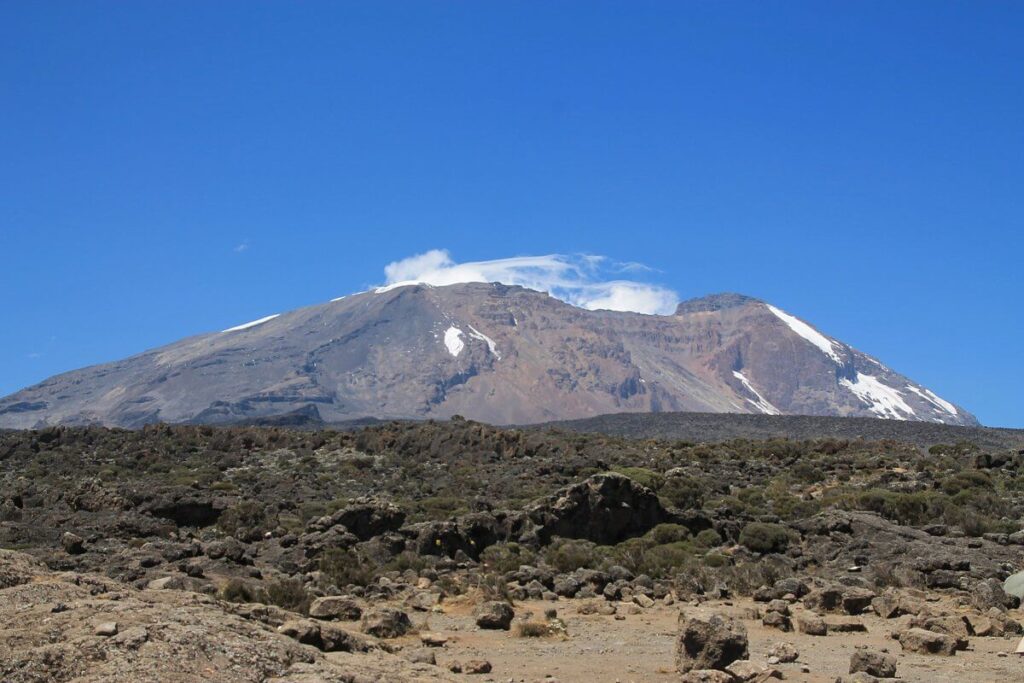
At the heart of the park is the 5896 Mt Kilimanjaro, Africa’s highest peak and one of the continent’s magnificent sights. It’s also one of the highest volcanoes and among the highest freestanding mountains in the world , rising from cultivated farmlands on the lower levels through lush rainforest to alpine meadows and finally across a barren Lunar landscape to the twin summits of Kibo and Mawenzi.
The lower rainforest is home to many animals, including white and blue monkeys, and elands are occasionally seen in the saddle area between Kibo and Mawenzi peaks.
A trek up summit Mount Kilimanjaro lures hundreds of trekkers each year, in part because it’s possible walk all the way to the summit without ropes or technical climbing experience. Yet, the climb is a serious undertaking, and only worth doing with the right preparation.
Summit Mount Kilimanjaro Uhuru Peak (5896m)
This stage of the trek can often involve up to 16 hours of strenuous walking, although it’s easy to bail out at any point and return the way you’ve come.
It’s usual to start very early in the morning, to see the sunrise from the crater rim, and to give you a chance of avoiding the mist. Also, the scree slope up to Gillman’s Point and the snow on the path to Uhuru Peak will still be frozen, which will make walking safer and less tiring. Sunrise is around 6am; allow five to six hours to get from Kibo Hut to Gillman’s Point plus another two hours to reach Uhuru Peak or from Barafu Camp to Stella point and another two hours to Uhuru Peak. This normally means leaving Kibo Hut between midnight and lam.
If you’re only going to Gillman’s Point, it is important not to arrive too early, as this will mean waiting for sunrise, sometimes in extremely cold conditions. Experienced guides will assess your abilities and pace the walk to arrive on the rim at the right time.
From Kibo Hut on the Marangu and Rongai Route, the path is easy to follow as it zig-zags up the scree. After Hans Meyer Cave (5182m) the gradient gets steeper and the walk becomes, without doubt, a slog. It seems endless but when you finally get to the rim at Gillman’s Point (5680m), it’s all worthwhile. You can see down into Kibo’s snow-filled crater, across to the spectacular cliffs of the Eastern Ice-fields, back down to the Saddle with the dark bulk of Mawenzi behind, and along the edge of the rim to Uhuru Peak.
Most people are happy reaching Gillman’s or Stella’s Point, especially when they see how much further it is to Uhuru, but if you’re feeling good and there’s still time, it’s well worth carrying on to the summit. The walk around the crater rim, with the steep drop into the crater on one side and the smooth snow-covered outer slopes of the dome on the other, is one of the most spectacular in Africa. From Gillman’s to Uhuru through Stella point takes another two to three hours.
At Uhuru Peak (5896m) there’s a flagpole, a plaque inscribed with a quote by President Nyerere, and a sign to say you’ve reached the highest point in Africa. If the weather’s good you might want to revel in your success and take in the views. If the weather is bad you’ll probably take a quick photo and hightail it down again.
The return from Uhuru to Gillman’s takes about one to two hours and to Stella takes few minutes if you will descend via Machame Route. You should aim to be back at Gillman’s about three hours after sunrise, as after this time the top layer of snow becomes wet and much harder for walking.
From Gillman’s back down to Kibo Hut or Stella to Barafu Camp the scree is blissfully easy-going compared with the slog up. An easy walk takes about two hours. If you’ve got strong knees and nerves of steel you can run down the scree and be back at Kibo Hut or Barafu Camp in less than an hour. From Kibo Hut, retrace the path to Horombo Hut – another three to four hours and from Barafu Camp to Millenium Camp takes about six to 7 hours.
On the last day, retrace the route, following the clearly marked path down to Marangu or Mweka Gate.
The Kilimanjaro massif has an oval base about 40m to 60km across, and rises almost 5000m above the surrounding plains. The two main peak areas are Kibo, the dome at the centre of the massif, which dips inwards to form a crater that can’t be seen from below, and Mawenzi, a group of jagged pinnacles on the eastern side. A third peak, Shira, on the western end of the massif, is lower and less distinct than Kibo and Mawenzi.
The highest point on Kibo is Uhuru peak, the goal for most trekkers. The hight point on Mawenzi, Hans Meyer Point 5149m), cannot be reached by trekkers, and is only rarely visited by mountaineers, You can contact us for more details if you wish to go on Mawenzi route.
Kilimanjaro is considered an extinct volcano, although it still releases steam and sulphur from vents in the crater centre.
Frequently Asked Questions
What does summit night on Kilimanjaro feel like?
Summit night is both exciting and incredibly tough. You usually start hiking around midnight in freezing temperatures and complete darkness. Every step feels slow because of the altitude and exhaustion. The silence of the mountain, broken only by footsteps and wind, makes it feel almost surreal. It’s one of the hardest parts of the trek, but also the most memorable.
How does it feel to reach Uhuru Peak?
Reaching Uhuru Peak is an emotional and unforgettable moment. After days of trekking and a long night climb, seeing the famous summit sign feels unreal. Many people laugh, cry, or just stand quietly taking it all in. The sense of achievement is overwhelming because you’ve pushed your limits to get there. It’s not just about the view, it’s about what it took to reach it.
What are the views like from the summit?
The views from the summit are breathtaking and unlike anywhere else. At sunrise, the sky glows in shades of orange and gold over the African plains. You can see glaciers, ice fields, and clouds far below you. It feels like standing on top of the world. On a clear day, the landscape stretches endlessly in every direction.
Is summiting Kilimanjaro physically exhausting?
Yes, reaching the summit is physically and mentally demanding. The high altitude makes breathing difficult and can leave you feeling weak or dizzy. Combined with cold temperatures and lack of sleep, it really tests your endurance. Even simple steps require effort and focus. But with determination and support from your guides, it’s absolutely possible.
What happens after you reach the summit?
After celebrating at the summit, you don’t stay long because of the extreme altitude. Most climbers spend about 10, 20 minutes taking photos and enjoying the moment. Then, you begin the descent, which can feel just as challenging on tired legs. The journey down is faster but requires care to avoid slipping. By the time you reach lower camps, the sense of relief and accomplishment really sinks in.
Still have questions?
Our local safari experts are happy to help you plan the perfect African safari.