
Table of Contents
In terms of the Geography of Africa, Mt Kilimanjaro itself lies only a few degrees south of the equator. One would expect that due to its location, the geographical environment on Kilimanjaro would be typically tropical. Nothing could however be further from the truth. Conditions on the mountain are determined by altitude as opposed to latitude, and range from equatorial on the lower slopes to arctic around the summit zone.
A trip from the base to the summit of this giant Strata volcano truly is an exercise in biodiversity. The Lower Slopes of the mountain are now covered by banana and coffee plantations, which provide the main source of income to the local subsistence farmers of the area. Bordering these crops is the thick, humid Rain Forest which is brimming with enormous trees and striking wildflowers such as orchids and violets.
The Higher one travels up the mountain, the thinner the vegetation becomes. The wispy grasses and giant succulents of the heath and moorland areas are gradually replaced by resilient grasses and orange lichen. By the time one reaches the summit area, the only vegetation one will see are the most resistant of lichens which cling desperately to the formations of volcanic rock which characterise the mountain.
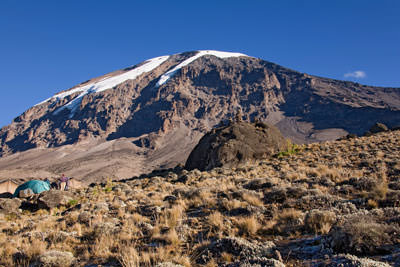
Like the vegetation one comes across on Kili, so the wildlife on the mountain also varies greatly according to altitude. Whilst the lower slopes and rainforest are teeming with both bird and animal life, conditions on the Upper Slopes ensure that they are inhabited by only the most resilient of creatures. Habitants of the heath and moorland areas include small rodents and birds, while the only organisms to survive the temperature extremes of the alpine desert are insects and spiders. On the rims of Kibo, and Mawezi themselves there is little if any sign of life, due to the fact essential elements such as liquid and oxygen are far too hard to come by.
Weather conditions on Kilimanjaro are relatively unpredictable and storms have been known to occur year in and year out. Generally however, January February and September are considered the best times of year to climb the mountain due to the fact that they are both warm and relatively dry. The two rainy seasons occur from March to June and then again from October through to December. These periods are best avoided due to the fact that visibility is poor and climbing conditions generally more treacherous.
Historical And Structural Geology Of Kilimanjaro Africa
The structural geology of Mount Kilimanjaro is an interesting one due to the fact that Kilimanjaro is no ordinary mountain, but rather an enormous stratovolcano. Stratovolcanoes are formed when erupted ash and cinders mix with lava flows and cool to produce a steep conical formation. These types of volcanoes usually take tens of thousands of years to materialize and may consist of a number of lava forms including dacite, basalt and andesite to name but a few.
On the Marangu Route you will more than likely come across a number of small cone shaped hills. These are known as ‘parasitic cones’ and are quite simply formations that are the product of offshoots of the main lava flow. In the event that you elect to do the optional Saddle Walk, you will pass a cliff face that appears to be stained with black and white stripes. Entitled Zebra Rock, this unusually patterned formation is the result of mineral rich rain water flowing down from the rocks above and streaking the almost black lava cliff white in places.
The formations on Kilimanjaro are not limited to volcanic rock alone, but also include incredibly impressive glacial configurations. While the sheets of ice on the mountain reflect the sun’s rays from above, typical Weather Patterns on the mountain ensure the heat from the ground melts the ice from below, resulting in the formation of intricate undercuts and overhangs.
Thousands of years ago, whole sheets of ice covered the mountain all the way down to almost 3000 feet. Today they can be seen only near the peak, and scientist predict that sadly within the next 35 years the snow cap may just disappear completely, confining the sight of the Great White Mountain to the pages of literature and the memories of those lucky enough to see it in it’s glory.
Volcanic Activity – Facts On Kilimanjaro’s Volcanic Centers
Volcanic Activity on Kilimanjaro these days is almost unheard of. Approximately one million years ago, the gentle rolling plains of the Northern regions of present day Tanzania collapsed and sunk to form a basin known as the Kilimanjaro Depression. Around 250,000 and 500,000 years later, a gigantic explosion from three volcanic centres resulted in the formation of the White Mountain, otherwise known as Mount Kilimanjaro.
While two of the Kilimanjaro’s impressive volcanic centres, Mawenzi and Shira are both extinct, the youngest cone, Kibo remains merely remains dormant. The last reported eruption on the mountain is thought to have occurred some time in the 1700’s, although there are still traces of volcanic activity within the centre to this day.
The three volcanic centres of Kilimanjaro vary in height, with Kibo being the tallest at 5896 metres, and Shira being the shortest at 3962 metres. Mawenzi falls somewhere in the middle at 5149 metres and is also the third highest peak in Africa, preceded only by Kibo and Mount Kenya.
The actual summits of the three centres vary greatly. Shira’s peak is a wide plateau which stretches across the entire width of the volcanic cone. Similarly, Kibo’s summit is also a broad crater that has a cavernous pit at its centre. The summit area of Mawezi by contrast is a sheer peak bordered by cliffs and gullies, which makes many portions of it completely unreachable.
The sharp ledges making up Mawenzi are made up of slow- cooling, incredibly durable Rocks that are typically resistant to weathering. By contrast, the Shira plateau has eroded substantially since ancient times, but is nevertheless still filled with interesting minerals, such as the obsidian pebbles that you may encounter on the Machame Route up the mountain.
Frequently Asked Questions
What type of mountain is Mount Kilimanjaro?
Mount Kilimanjaro is a stratovolcano, which means it was built up over time by layers of lava, ash, and volcanic rock from multiple eruptions. It actually consists of three volcanic cones called Kibo, Mawenzi, and Shira, each formed during different periods of activity. Kibo is the tallest and is currently dormant, while Mawenzi and Shira are extinct. The mountain’s shape and structure reflect millions of years of volcanic processes. Even though it is not currently erupting, it is still considered a potentially active volcano.
How was Mount Kilimanjaro formed?
Mount Kilimanjaro formed around three million years ago as a result of volcanic activity along the East African Rift system. This region is where the Earth’s crust is slowly pulling apart, allowing magma to rise to the surface. Over time, repeated eruptions built up the massive mountain we see today. The three cones developed at different times, with Shira forming first, followed by Mawenzi and then Kibo. This long geological history is what gives Kilimanjaro its complex and fascinating structure.
What are the main geographical features of Mount Kilimanjaro?
Mount Kilimanjaro rises dramatically from the surrounding plains, standing alone rather than being part of a mountain range. It has five distinct ecological zones, ranging from cultivated farmland at the base to glaciers at the summit. These zones include rainforest, heath and moorland, alpine desert, and the arctic summit zone. Each zone has its own climate, vegetation, and landscape. This unique layering of environments makes the mountain geographically diverse and visually stunning.
Why does Mount Kilimanjaro have glaciers at the top?
Despite being close to the equator, Mount Kilimanjaro has glaciers because of its extreme elevation, which reaches 5,895 meters at the summit. At such high altitudes, temperatures remain below freezing for most of the year, allowing ice to form and persist. However, these glaciers are shrinking rapidly due to climate change and rising global temperatures. Scientists believe they may disappear entirely within the coming decades. Their presence is a striking reminder of how altitude can influence climate.
Is Mount Kilimanjaro still volcanically active?
Mount Kilimanjaro is not currently erupting, but it is classified as a dormant volcano rather than extinct. The last major volcanic activity occurred hundreds of thousands of years ago, though some minor activity may have happened more recently. Scientists have found evidence of geothermal heat beneath the summit crater of Kibo. This suggests that magma still exists deep below the surface. While an eruption is unlikely in the near future, the mountain is still geologically alive.
Still have questions?
Our local safari experts are happy to help you plan the perfect African safari.


