
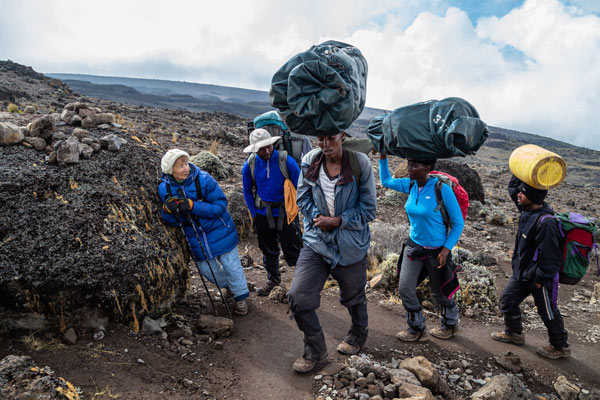
Your Porter will quite possibly become your best friend during your summit attempt of the Great White Mountain. From the moment that one begins to ascend the mighty form of Kilimanjaro, the importance of the native porters will be apparent. Aside from carting the majority of climbers’ supplies up the mountain, porters also prepare wholesome meals and on the other Route than Marangu both erect and break down tented camps.
Many workers on the mountain begin as porters. After three years of being a porter, an individual may go on to become an assistant guide. Subsequent to this they may go on to become Head Guides, by which time they will have sufficient training to individually lead climbers safely up and down the mountain should circumstances require it.
The majority of guides and porters on the mountain descend from the local Chagga population and reside either Moshi or Marangu. Unlike climbers who are unaccustomed to both Altitude and conditions on the mountain, porters and guides are well adjusted to the environment on Kilimanjaro. Due to their regular ascents and excellent levels of Fitness, they seldom if ever succumb to the effects of altitude. What they do however often suffer from is exposure, due to lack of proper clothing and sleeping materials.
Whilst all porters are paid set wages, these are often incredibly meagre and no where near sufficient for them to be able to support themselves alone, let alone their families as well. Most therefore rely on the generosity of the Western climbers whose baggage they carry on their back’s from start to finish.
When considering how much to tip a porter, it may be a good idea to take into consideration how far one would in fact have gotten without their assistance. Most climbers quickly realise that the answer to this question is not very far at all and as a result are generally reasonably generous when it comes to tipping. Both porters and guides are happy to accept tips in any currency, although Tanzanian Shillings and US dollars are generally preferred. In addition, any old items of clothing and sleepwear which climbers feel they will not make use of again will be generously welcomed to say the least.
Guides & Porters
The difference between success and failure can come down to the quality of your guide and the hard work put in by your porters.
The whole support team should not be under-rated. These guys are fantastic and they are the ones who make the whole climb possible.
The guides know what they are doing. They’ve climbed the mountain many times before and have been trained in first aid. They can recognise the symptoms of acute mountain sickness and they know how to deal with it. They have absolute authority on the mountain, and they are able to decide whether you are fit to continue or need to return to a lower altitude.
They are particularly good at raising morale and encouraging you when you are at your lowest point, struggling to continue up the mountain!
The porters are the foundation of a good climb. Every piece of kit, everything you eat and everything you wear has to be schlepped up that mountain. Sadly there are still budget companies in Tanzania that will exploit these guys. They come from poor backgrounds and if they have no other source of income can be persuaded to do ridiculously things.
We were among the first company in the Tanzania to adopt a formal written porters’ policy over a decade ago. We campaigned, along with Tourism Concern, to get other companies to take a look at the issues and to do the same.
As a local operators in Tanzania we became partners for responsible travel with the Kilimanjaro Porters Assistance Project (KPAP) which strives to improve conditions for porters through a number of different measures and monitoring schemes. They had this to say about our input in the early days:
“I can’t say thank you enough for your support of our work! Your local Kilimanjaro company was the most receptive to our input ever, and extremely agreeable to complying with our requests. You have helped bring about critical changes in their practices and we are very grateful as well as their crew, I am sure!
Karen Valenti (KPAP)”
Frequently Asked Questions
Do you have to use porters when climbing Mount Kilimanjaro?
Yes, you are required to use porters when climbing Mount Kilimanjaro because independent trekking is not allowed. All climbers must go through a registered tour operator, which includes a team of guides and porters. This rule helps ensure safety, proper navigation, and environmental protection. Porters carry most of the heavy gear, allowing you to focus on the hike. It also supports local employment and the mountain’s tourism system.
What exactly do porters do on a Kilimanjaro climb?
Porters play a very important role by carrying your main luggage, camping equipment, and food supplies. They often walk ahead of the group to set up tents and prepare camp before you arrive. This allows you to rest and recover after each day’s hike. They also assist the guides in making sure everything runs smoothly during the trek. Their work makes the entire experience more comfortable and organized.
How much weight do porters carry on Kilimanjaro?
Porters usually carry a limited amount of weight per person, typically around 15 to 20 kilograms depending on regulations. This includes your personal duffel bag as well as shared equipment. Responsible tour operators follow strict guidelines to protect porter welfare. It is important for climbers to pack wisely and not exceed the allowed limits. Keeping your load reasonable helps ensure fair and safe working conditions.
Can you carry your own gear instead of using porters?
While you will carry a small daypack with essentials like water, snacks, and extra clothing, you cannot carry all your gear alone. The rules of Mount Kilimanjaro require the use of a support team. Even experienced trekkers must follow this system when climbing the mountain. The setup is designed to improve safety and manage the challenging environment. It also helps preserve the trail by controlling how trekking is organized.
Should you tip porters on a Kilimanjaro climb?
Yes, tipping porters is a common and expected part of climbing Kilimanjaro. Their hard work and dedication contribute greatly to your success and comfort. Tips are usually given at the end of the trek as a way to show appreciation. Many tour companies provide guidelines on how much to tip each crew member. Supporting porters through fair tipping is an important part of responsible travel.
Still have questions?
Our local safari experts are happy to help you plan the perfect African safari.


