Table of Contents
50 percent of trekkers who climb Mount Kilimanjaro choose the Marangu route trekking. It’s a short, scenic, but steep trek that’s anything but simple, especially if done in 5 days, which explains why only around one out of every three climbers on this route makes it to Uhuru Peak.
Extending the expedition over 6 days of trekking, or perhaps 7 days, as outlined below, is preferred and raises your chances of success significantly. The Marangu trail can be gloomy and muddy depending on the season and it is frequently congested. Because of its popularity in the former days, the trail has deteriorated significantly. When it rains, the lower slopes develop into a mudslide in several areas.
Painting covers the three large lodging huts: Mandara, Horombo, and Kibo, and there’s further reasoning that the Marangu route could be the easiest approach to Mount Kilimanjaro (thus the trail’s nickname, the “Coca-Cola Route”).
Mattresses, solar lighting, kitchens, toilets, and a rescue crew are all included. Bunks must be reserved through Marangu Gate’s park headquarters (your hiking company can do this for you) or contact Kilimanjaro ASAP for more details.
Except for individuals who ascended via the Rongai Path and descend through this route, camping is not permitted.

Day 1: Marangu Gate to Mandara Hut
The Marangu route begins at Marangu Gate (1860m), 5.6 kilometers north of Marangu small village, where your guide will pay park fees for you. You can contact Kilimanjaro ASAP for the organized climb.
You can also get last-minute goods here, such as energy food. We recommend beginning as soon as possible to give yourself plenty of time to experience the maze of rainforests and to maximize your chances of escaping afternoon rains which are common along this route.
In the rain, the entire day’s walk (8km; allow 3 hours) becomes quite slick and slippery, so be cautious. Even if it isn’t raining, you may get wet along this part since the cloying fog drenches everything.
The large trail right after the gate descends into the deep rainforest. While the porters take the walking path to the right, you should be guided by our mountain Guides from Kilimanjaro ASAP down the narrower, designated path to the left, which follows a tiny creek and provides a better perspective of the forest.
At Kisambioni, the two trails merge after about 5 kilometers. The Mandara Hut (2705m) is 3 kilometers away from here. If you start early and feel up to it, there’s a 1.5-kilometer hike from Mandara Hut to the rim of Maundi Crater (2800m), a volcanic eruption remains from which there are stunning views. The crater can potentially be incorporated into the following day’s hike which is the acclimatization day for a 6 days hike.
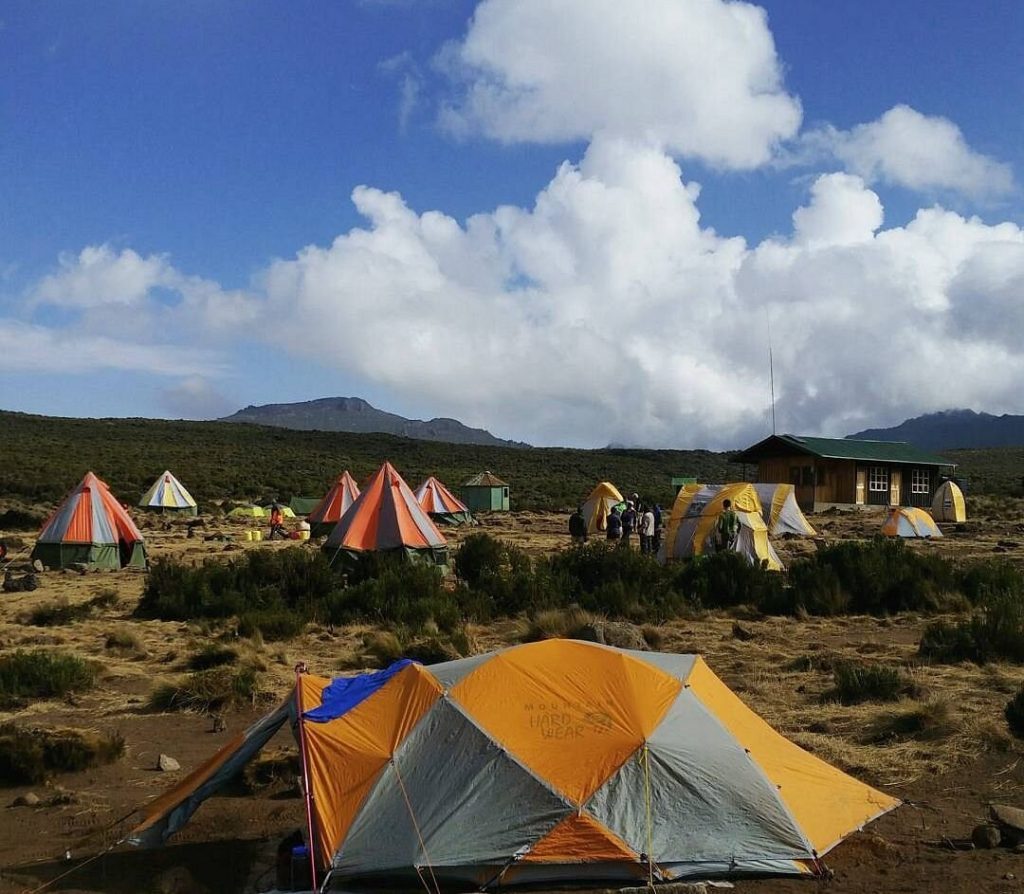
Mandara Hut is a collection of cozy wooden huts located just within the forest’s upper limit. Each cottage has a room and bunk beds. A spacious two-story house with large dormitories on top and a sharing dining space underneath is the exception. Eat well, as you may lose your appetite as you climb higher.
Day 2: Mandara Hut to Horombo Hut
The track comes out from the forest and heads northwest after an early breakfast (aim for 6.30 a.m.). From here, if the weather is fine, you can see the rugged Mawenzi Peak to the north and the grasslands to the south.
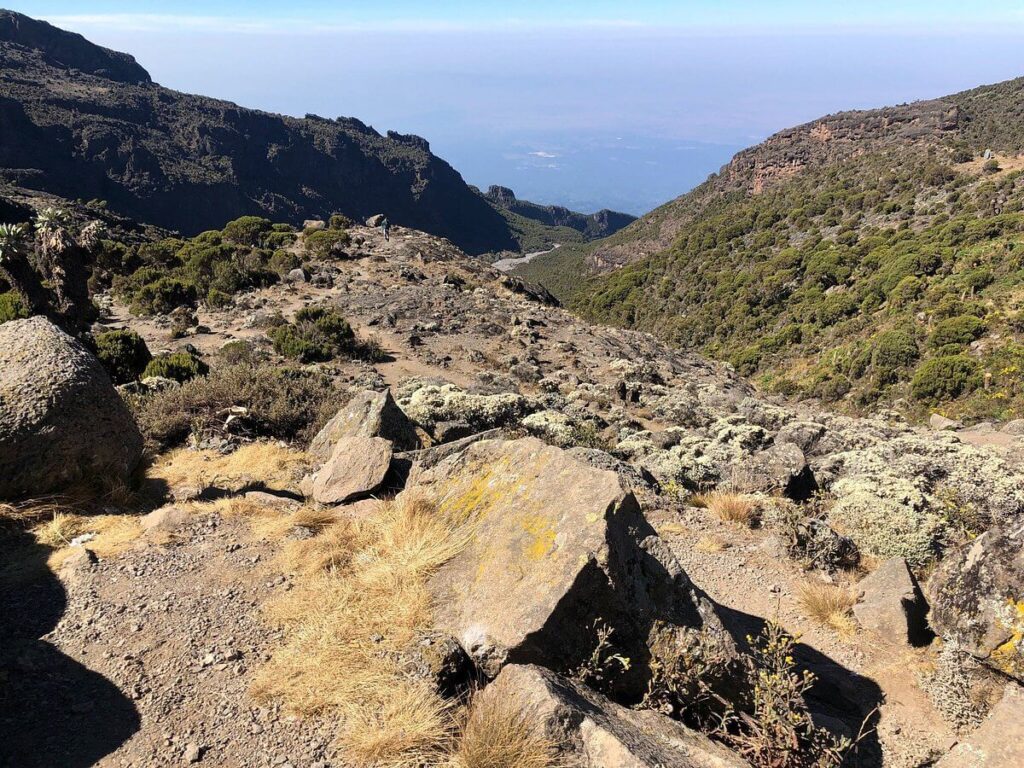
The path ascends through grasslands and passes a stream before emerging onto meadows, which spreads out into bizarre moorland with plants and small shrubs. Don’t worry if it’s foggy — the sight of the flora rising from the mist in a cocoon of silence can be spectacular, and there’s a good chance of bright weather in the afternoon.
Rough stands of enormous groundsels and gigantic lobelia take over as you reach Horombo Hut, 12km from Mandara, via a sequence of moorland ravines, imparting an equally weird and surreal appearance to the scene, which is often accentuated by Horombo’s stunning sunsets.
Horombo Hut (3714m) is a cluster of huts in a steep valley, comparable to Mandara. Down the hill, there are a few old-fashioned long drops and newer restrooms flushed with water supply from a spring below the huts. After dusk, it gets very chilly, so cover up warmly. Allow 5 to 7 hours for the day’s trek.
Day 3: Horombo Hut
Even if you’re in terrific physical form, a rest day at Horombo Hut is recommended, as most trekkers start feeling the effects of altitude sickness on the way up to Horombo Hut. Spend at least a couple of hours trekking to a higher altitude to help yourself acclimate; most hikers go to Zebra Rock (4000m), which is named after its unusual weathering pattern. If you’re feeling exceptionally fit, a day excursion to Mawenzi Hut (4538m), located at the base of Mawenzi Peak, is an option.
Day 4: Horornbo Hut to Kibo Hut
If your body hasn’t properly acclimatized, the next step, 9.5km up to Kibo Hut, might be challenging. Keep a watch out for symptoms of acute altitude sickness beyond basic headaches, and also depart Horombo earlier, because you’ll have short rest or sleep in the evening before the summit attempt. It took 5 to 7 hours to complete this stage.
Two tracks separate just after Horombo, both leading to the Saddle, a large basaltic ridge between Mawenzi and Kibo peaks.
The right-hand track, which is rough and eroded, heads north and is the faster, though more difficult, of the two (2-3 hours vs. 3-4 hours). A track leading east from the Saddle leads to the 4538m mark on Mawenzi, which is the highest point on the summit that can be reached without technical gear. Together with your guide, you will continue straight ahead instead.
It takes three to four hours to get to Kibo Hut, which is located in a surreal alpine desert of reddish gravel and stones. The alternative route from Horombo to the Saddle takes about four hours and leaves you little under two kilometers from Kibo Hut. Both routes have a number of steep uphill and downhill sections. There are very strong uphill and downhill stretches on both trails.
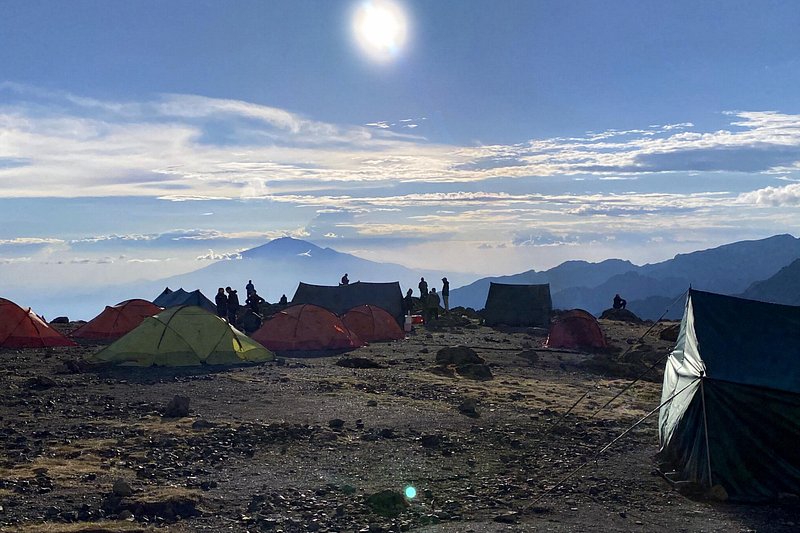
Kibo Hut (4713m) is a stone structure with a dining hall and bunk beds for lodging. Outside the shelters are long-drops, so be cautious at night. There isn’t any stream water at this stage, so your guide will instruct you to get some at Horombo Hut. Since you will commence the climb the same night, try to get some rest in the afternoon and evening, as the second stage, which begins about midnight, is by far the most difficult.
Days 5 and 6: Horombo to the summit and back down
The summit attempt on day 5 is the most difficult and time-consuming phase of the trek, requiring 5 to 6 hours to reach Gillman’s Point (plus a further ninety minutes to reach Uhuru Peak if you’re still upright), followed by 9 to 10 hours descend. Trekkers set out between 11 pm and 1 am for the last ascent after a generally restless night’s sleep due to the cold and altitude.
Temperatures are much below freezing, and vision is limited, particularly if there is no moon or if torches fail. The track leads past Hans Meyer Cave, which is useful for a rest stop, before descending into a difficult series of single-file zigzags up slippery scree, which requires an enlightenment mindset.
A brief rocky struggle at the top of the zigzags brings you within striking distance of Gillman’s Point. The thin air demands numerous breaks, and most trekkers become dizzy and queasy, as well as suffering from migraines, over this stretch.
Many hikers come to a halt at Gillman’s Point (5685m), on the crater rim, to be cheered up by the magnificent scenery and the sun rising from behind Mawenzi Peak.
If you’re up for it, a 90 minutes more difficult trek around the crater rim past Stella Point — where the Machame route meets up — and Hans Meyer Point will lead you to Africa’s roof, Uhuru Peak (5892m).
Those 90 minutes (or two hours if you’re really messed up) may not seem like much, but they’ll probably be the most difficult, painful, and hopefully rewarding 90 minutes of your existence.
Even if your only aim right now is to get down as quickly as possible, the sunrise above a sea of glass (clouds) is remarkable and extraordinary, as is the feeling of euphoria (though most of the trekkers reach around an hour after sunrise).
Whatever time you reach the Uhuru peak don’t forget to take a photo because of the pounding headache you’ll most likely be experiencing, many people fail to do so but you can always remind your guide to help you take a photo.
Hiking inside the crater is feasible if you organize it with our expert ahead of time (at extra cost). The crater is 2 kilometers in circumference and 300 meters deep, and it has a smaller crater named for Dr. Richard Reusch, who discovered the frozen leopard made famous by Hemingway in 1926. An ash pit is in the center, with several minor yet active steam volcanic eruptions on the northern and eastern rims.
It’s also not a good idea to spend a night on the summit (Furtwangler Camp, 5600m) unless you’re planning on hiking for at least nine days, as you’ll need to be completely acclimatized to prevent getting altitude sickness.
Most trekkers just stay at the freezing summit for a few minutes before returning down. By noon, most trekkers may return to Kibo Hut, relax, and afterward make their way to Horombo Hut for their closing show on the mountain. Here is when the tipping celebration may take place
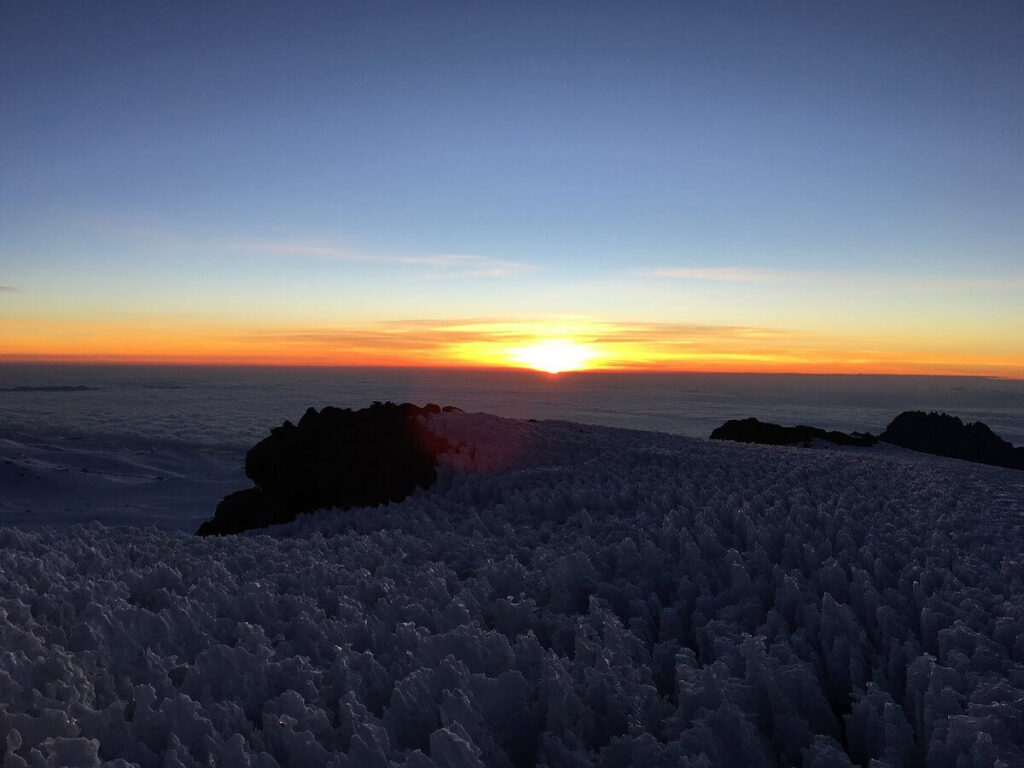
The last session (day 6) should be relaxing, however, your knees may be hurting.
Take it slow and use a walking stick if it gets worse. By lunchtime, Mandara Hut is usually reached, and the park gate is by late afternoon. Don’t forget to bring your certificate with you from the park authority at the entrance. In case you wish to trek this Marangu Route, kindly reach us at Kilimanjaro ASAP or Safari ASAP. We will be happy to assist you on your next trek to Mount Kilimanjaro
Frequently Asked Questions
What makes the Marangu Route unique compared to other Kilimanjaro routes?
The Marangu Route is often called the “Coca, Cola Route” because it is one of the oldest and most established trails on Mount Kilimanjaro. It is unique for its gradual ascent and relatively gentle slopes, making it ideal for first, time trekkers. Unlike some other routes, it offers hut accommodations along the way instead of camping, which provides a more comfortable trekking experience. Hikers enjoy scenic views through lush rainforests and alpine moorlands. Its popularity also means it can be busier than other routes, so booking in advance is recommended.
How many days does it usually take to complete the Marangu Route?
Typically, the trek takes 5, 6 days depending on your pace and acclimatization needs. The route covers around 65 kilometers , 40 miles, round trip, culminating at Uhuru Peak, the summit of Mount Kilimanjaro. Some trekkers choose a 5, day plan, but adding an extra day increases your chances of reaching the summit safely. The huts along the route allow for overnight rests at Mandara, Horombo, and Kibo huts. It’s important to allow your body time to adjust to the high altitude to reduce the risk of altitude sickness.
How difficult is the Marangu Route for beginners?
The Marangu Route is considered one of the easier options for beginners due to its moderate gradient and hut accommodations. However, the trek is still physically demanding, especially the final push to the summit from Kibo Hut. Proper training, including long hikes and cardio exercises, is recommended before attempting the climb. Altitude sickness can still be a challenge, so listening to your body and taking it slow is essential. Many trekkers successfully summit on this route with good preparation and pacing.
What should I pack for a Marangu Route trek?
Packing the right gear is crucial for a successful Marangu Route trek. Essentials include warm clothing for the cold nights, waterproof jackets, sturdy hiking boots, a hat, gloves, and a good sleeping bag for the huts. Daytime layers should be light and breathable for trekking through forests and moorlands. Don’t forget trekking poles, a water bottle, sunscreen, and personal toiletries. Guides often provide porters to carry heavier items, so you only need to carry a daypack with water, snacks, and personal items.
What’s the best time of year to hike the Marangu Route?
The best periods for trekking the Marangu Route are during the dry seasons, from January to mid, March and June to October. These months offer more stable weather, clearer skies, and less rainfall, improving your chances of summiting. Avoiding the rainy seasons helps prevent slippery trails and difficult conditions in the rainforest and moorland zones. Early morning summit attempts are common to witness breathtaking sunrise views from Uhuru Peak. Planning your trek during these months maximizes safety and the overall trekking experience.
Still have questions?
Our local safari experts are happy to help you plan the perfect African safari.