By Camilla Howard (South Africa) – Extract from the book Dreamers & Doers.
When I was 19 years old my father climbed Kilimanjaro. I remembered how proud and in awe of him I was. At the time I may have let my mind wander, whether I too would one day be able to do it, but I am sure the fear of the unknown and my perception of the enormity of the challenge would have stopped that train of thought right there and then!
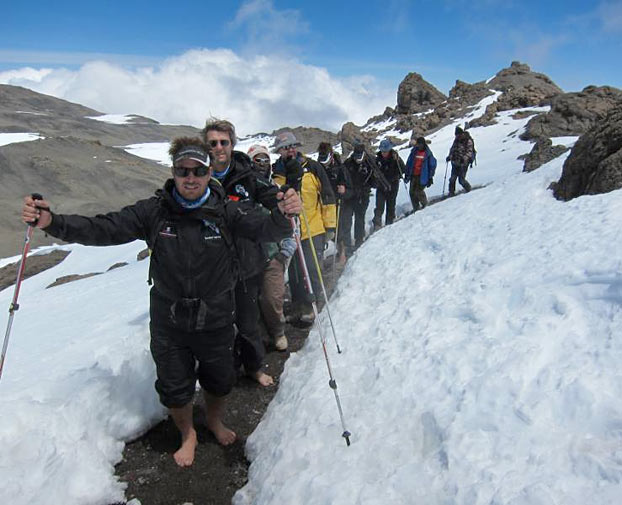
At the time of his death a couple of years later I was completely heartbroken and thought I would never get over it. But I did: I came out stronger and suddenly the world was a lot less scary. In fact, nothing really scared me anymore, and I saw the world through different eyes. A few years later I gave myself permission to leave my job behind for 12 months and pursue my passions of photography, adventure travel and charity work. It was during one of my adventures on this sabbatical that I met Matt Botha and Andrew King. We were on a social rally around southern Africa, racing through seven countries in 17 days. They were barefoot the entire trip, and one evening they told me they were planning to reach the summit of Kilimanjaro without wearing shoes. Naturally, I thought they were nuts, but I decided that come hell or high water I was going to join their team – albeit with shoes.
They were going to be raising money for the Red Cross War Memorial Children’s Hospital, which is an institution very close to my heart as this was where my younger sister’s life was saved when she was a baby. On a personal level, I was now sold! I would be doing something that I felt would bring me closer to my dad in a strange spiritual way and support a brilliant hospital.
Back home in Cape Town, having secured myself a spot on the team, we began training on the slopes of Table Mountain. Their craziness must have started to rub off on me because on one such training hike I decided I was sick of feeling left out (already being an outsider as the only girl on the team) and took my shoes off. I quickly realized how free I felt and more stable and in touch with the earth beneath me. The next day I joined them in the ice chamber and was amazed that I lasted in there longer than some of the boys! It was then that I decided to officially join the ‘barefoot team’.
From the very beginning of the expedition Matt and Andrew knew that this would be a difficult story to tell. And I suppose just like any expedition there would always be those that would never understand why – usually those who sit in their comfortable little offices who would think we were crazy and just wasting our time on a pointless exercise. But likewise they knew that there would be those that would understand. So the first question was always the same: why did we want to walk up the highest mountain on the African continent, the snow and glacier covered dormant volcano of Kilimanjaro, entirely barefoot?
We were asked this question all the time, and to be honest we are probably all still trying to figure out the answer for ourselves. But at the end of the day, when we look back at what we achieved and see how people responded, we know why, even if we can’t properly explain it.
It is obvious to see that as humans, we all live and die by a very defined set of boundaries or paradigms. And these are boundaries that are usually drummed into us at school or by our parents (or in this day and age by the vast amount of media we get bombarded with). And then if we don’t have our own opinion, we usually just end up leveraging off somebody else’s just to sound informed.
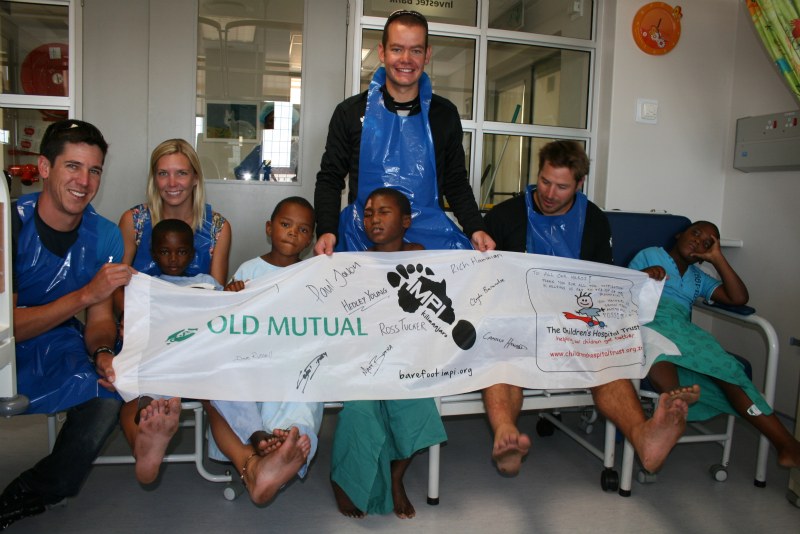
So when we came up with the idea of the Barefoot Kili attempt, it proved an idea that overshoots the mark for what most people would consider possible; one that is all too easy for them to automatically disregard as crazy, or even irresponsible. And I suppose, in the simplest terms, that is what we hoped to achieve by climbing Kilimanjaro barefoot: to do our little bit to break down these barriers of conventional thinking in society.
There was only one guide we found who thought the same way we did. 9 out of 10 companies we approached with the idea don’t us it was impossible and they would not take the risk of having us fail. Sean Disney from Adventure Dynamics, however, told us that if the weather gods shone on us, we did the necessary training and we got lucky then it was “Possibly not impossible”! We knew he was our guy. Then we got Dr Ross Tucker from the Sports Science institute who’d done a thesis on barefoot running and had been involved in testing the human limits on a polar expedition to join the team. As a team we put together a fail-proof strategy to make it to the top. Sean chose the Rongai route for us as he thought it would be easiest on our feet and give us the necessary time to acclimatize to the altitude due to the long yet gentle ascent on day 4.
We arrived early at Mawenzi Camp on day 3, after a strong and stunning climb. It was by far the most beautiful of the camps, nestled in next to a mountain tarn. I seized the opportunity to have my first (pocket) shower in four days. What a treat to have clean hair and feet! When the banter around the lunch table turned to the increase in the Dimox-to-Flatulence ratio, followed by the invention of crushed velvet willy-wiping devices, I decided to retire to my tent for a mini-pedicure. Goodbye French, hello candy pink. I’m not much of a girlie girl but when you’re surrounded by that much testosterone I guess you crave a girlie fix.
The temperature plummeted as we ascended on our afternoon acclimatization hike. We tested our SATS; mine had dropped from 93% on the first day to 83%. This is the percentage of your red blood cells that are carrying oxygen. While I was assured that this was plenty high enough, I was at least 4% lower than the SATS of the boys. I was used to my body outperforming or matching my peers, so this really annoyed me.
After an uncomfortable, largely restless and freezing night, I woke at 5:30 feeling anxious and apprehensive about this potential penultimate climb to Kibo hut – day 4. My little toe, after being stubbed four times, had drawn a bit of red paint and throbbed all night.
However, as the African sun rose, so did my spirits and the day was far better than expected, despite still being pretty tough. I was sure that the next day we would be pushed to beyond our limits and in essence really start living and growing as people. The amount of nervous, excited energy building up inside me was almost indescribable.
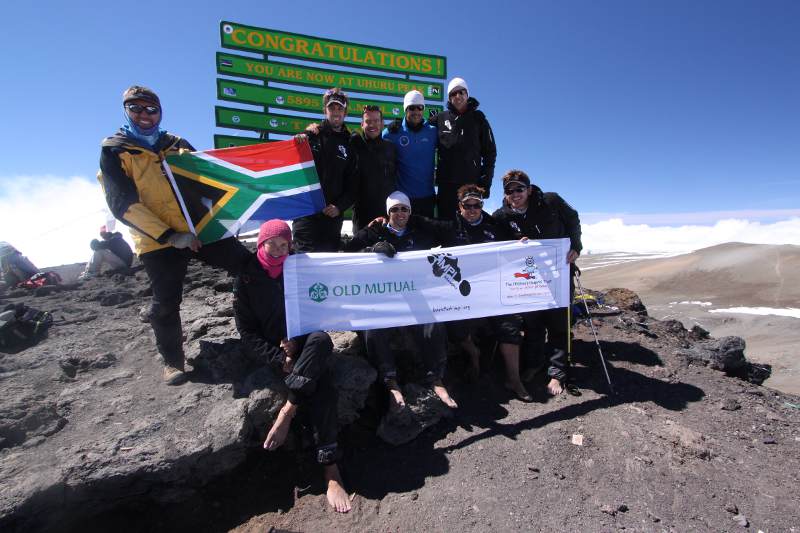
On the morning of day 5, we started our summit at 6:45am. Most people start their ascent at midnight but we needed to wait for the sun to rise and heat the earth a bit before we left. It was quite disconcerting passing other climbers who had failed to summit and looked terrible, falling over and vomiting all over the place. We pushed on and made it to Gilman’s Point where we took a break for lunch. From Gilman’s to Stella Point we passed through the snowfields. Instead of panicking when we saw the thick white snow ahead of us we were calm and almost quite excited! We had trained so hard for it and it was time to put our conditioned bodies to the test!
From Stella Point you could see the sign at the summit just over a kilometer away, and that was the first time I knew we were going to do it. As we skirted around the rim and saw the sign in front of us, the mood started to change. It had been a long hard road to get there, especially for Matt, who had taken the brunt of the naysayers. But when we stood on the peak as a full team you could feel the respect and pride in the air. It was a wonderful moment…
So for us, this was really just our humble little way of saying: “Risk everything by taking a small step to a new way of thinking and you will be handsomely rewarded.” The unknown is a dangerous and scary place for most people. We hear it all the time. “You have to step outside your comfort zone.” But what I have come to realize is that stepping out of your comfort zone doesn’t only apply to the physical activities you take on and the places you travel – but more importantly involves the risks you’re prepared to take in changing the way you think – this is when the magic happens!
Frequently Asked Questions
What does “Barefoot Kilimanjaro” really mean?
“Barefoot Kilimanjaro” sounds extreme, but it’s really about stripping things back to the basics. It can mean literally climbing with minimal gear, or symbolically facing the mountain with vulnerability and courage. Without the usual comforts, every step feels more real and personal. You become more aware of your body, your limits, and the terrain beneath you. In many ways, it’s less about the feet and more about the mindset.
Is it actually possible to climb Mount Kilimanjaro barefoot?
Climbing Mount Kilimanjaro barefoot is extremely challenging and not recommended for most people. The terrain includes sharp rocks, freezing temperatures, and rough trails that can easily cause injury. While there have been rare cases of people attempting it, they usually have years of conditioning and experience. Proper footwear is essential for safety and comfort on the mountain. Still, the idea captures the spirit of pushing limits in unconventional ways.
What lessons can someone learn from a “barefoot” journey?
A barefoot journey teaches humility and resilience in a very direct way. Without layers of protection, you feel every challenge more intensely. It reminds you that growth often comes from discomfort and facing things head, on. You also learn to appreciate small victories, like each step forward. In the end, it becomes a powerful metaphor for life’s tougher moments.
Why would someone choose such an extreme approach?
For some, it’s about testing their mental and physical limits. Others may do it to raise awareness for a cause or to inspire people. There’s also a desire to connect more deeply with nature, without barriers. It’s not always about proving something to others, but understanding yourself better. Sometimes, extreme choices come from a need for meaning and challenge.
What does “Over and Out” signify after such a journey?
“Over and Out” feels like a final sign-off after completing something intense and life, changing. It reflects a sense of closure, relief, and accomplishment. After such a demanding experience, there’s often a quiet pride rather than loud celebration. It’s a way of saying the journey is complete, and the message has been delivered. At the same time, it hints that the lessons learned will carry on long after the climb ends.
Still have questions?
Our local safari experts are happy to help you plan the perfect African safari.