
Table of Contents
The hiking programs for Kilimanjaro can be easily modified as desired. The prices for climbing Kilimanjaro are based on you being two or more people climbing Kilimanjaro together. For solo trekkers on Kilimanjaro, there is a fee of USD 450. All travel programs to climb Kilimanjaro include camping except for the Marangu trail which also has cabins.
All programs to climb Kilimanjaro
Kilimanjaro, Lemosho route 8 days Inquiry
Kilimanjaro, Machame route 7 days (Whiskey route) Inquiry
Kilimanjaro, Marangu route 6 days (Coca Cola route) Inquiry
Kilimanjaro, Rongai route 7 days Inquiry
Kilimanjaro, Northern Circuit route 9 days Inquiry
Kilimanjaro, Umbwe route 6 days Inquiry
Feel free to combine your Kilimanjaro hike with a safari and sun and swim in Zanzibar.
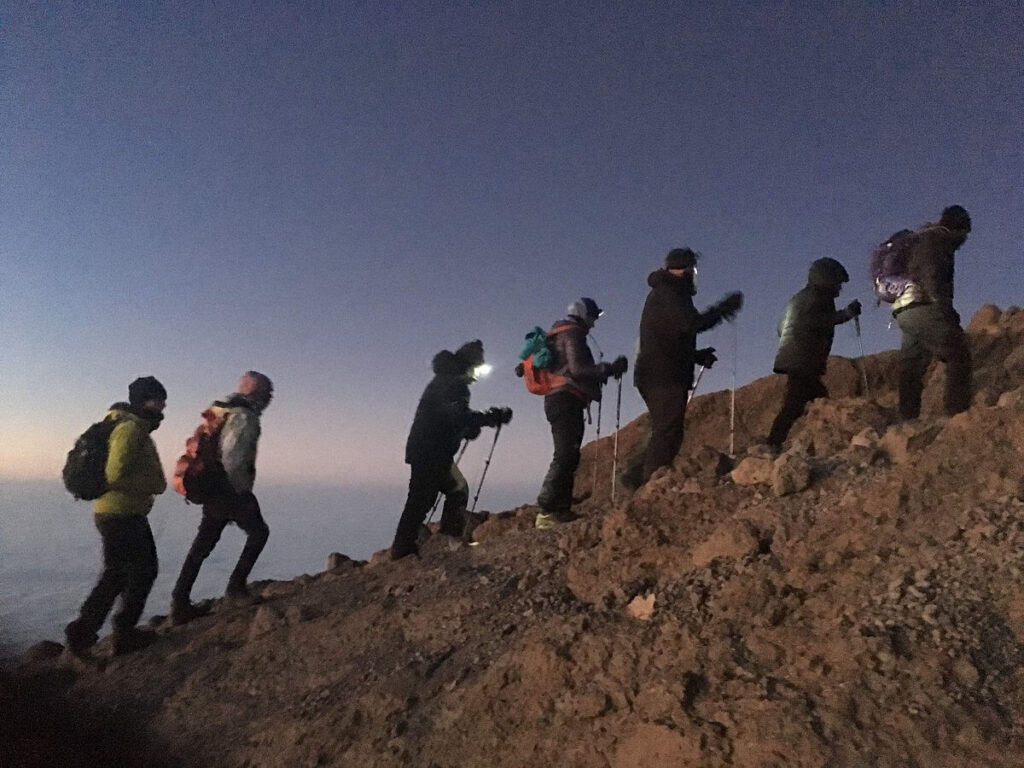
The following is included in the price for climbing Kilimanjaro:
- local transport to the starting point for the trek and return to Arusha/Moshi after the trek
- 3 meals (including drinking water/tea/coffee/chocolate) per day during the trekking days
- all national park and camping fees
- tent equipment (tent, sleeping mat , sleeping bag) or overnight accommodation in mountain cabins – multi-bed rooms (Marangu trail). However, we recommend that you bring your own sleeping mat and sleeping bag from home, as the quality of rented equipment in this regard is generally substandard and insufficient.
- staff: hiking guide (English speaking), assistant guide, cook, porter 3-4 per hiker
- hotel accommodation in Arusha/Moshi the night before and the night after the safari trip at the Panama Garden Resort – a simple and pleasant low-cost hotel (it is of course possible to upgrade the accommodation if desired ) The following are not included in the price when climbing Kilimanjaro:
- drinks such as alcohol, soft drinks, etc.
- tipping staff (suggested level; guide US$ 20 per day, assistant guide and cook US$ 15 per day, and per porter US$ 10 dollars per day – this per hiking group, so if you are, for example, 2 hikers, you share the above cost)
It may be necessary to book the Marangu trail on Kilimanjaro several months in advance before high season periods (July–September, December–February), because then the cabins are usually fully booked – another option that remains is camping along the Marangu trail as well. On the other trails along Kilimanjaro, we can easily organize a Kilimanjaro expedition at short notice.
Acclimatization on Kilimanjaro
A standard program along any of Kilimanjaro’s Marangu, Machame or Rongai hiking trails covers 6-7 hiking days, while Lemosho takes 7-8 days. In all our programs for climbing Kilimanjaro there is a so-called “acclimatization day” when you “stop” at 4000 meters altitude for a day and get your body used to the high altitude – that day also includes hiking to a slightly higher altitude and then returning down for the overnight stay itself (a tactical maneuver for acclimatization to high altitude). However, all standard programs for climbing Kilimanjaro can be modified according to your wishes as a customer, for example if you wish to include extra acclimatization days during your ascent of Kilimanjaro (this costs 350 US dollars per person per day).
Altitude sickness
Altitude sickness or AMS (from the English “Acute Mountain Sickness”) is a symptom that hikers on Kilimanjaro sometimes suffer from due to the low air pressure at high altitude. Drink water to avoid altitude sickness on Kilimanjaro. The higher you get on Kilimanjaro, the more the air pressure drops and the greater the risk of suffering from altitude sickness. It is very individual if you are affected and the symptoms are not directly related to physical condition or age. Myself and porters who go up Kilimanjaro every day occasionally suffer from altitude sickness.
For those who are sensitive, symptoms can begin to appear already at low altitudes such as 2000 meters above sea level. Most hikers who climb Kilimanjaro can feel some symptoms of altitude sickness already at 2,500 meters above sea level. Serious symptoms of altitude sickness can occur at about 3000 meters above sea level, but it is only at altitudes above 3500 meters above sea level that healthy people need to be actively observant of altitude sickness symptoms. Dehydration (due to the dry air at high altitudes) is one of the causes of altitude sickness, so it is important to drink a lot of water when climbing Kilimanjaro.
Symptoms of altitude sickness include loss of appetite, nausea and headache. A quick way to recover from altitude sickness is to immediately descend to lower altitudes. One of the most important tasks of the Kilimanjaro guides is to keep an eye on our hikers and make sure they are constantly drinking and not overexerting themselves. You will hear the familiar word pole pole (take it easy in Swahili) many times during your ascent of Kilimanjaro.
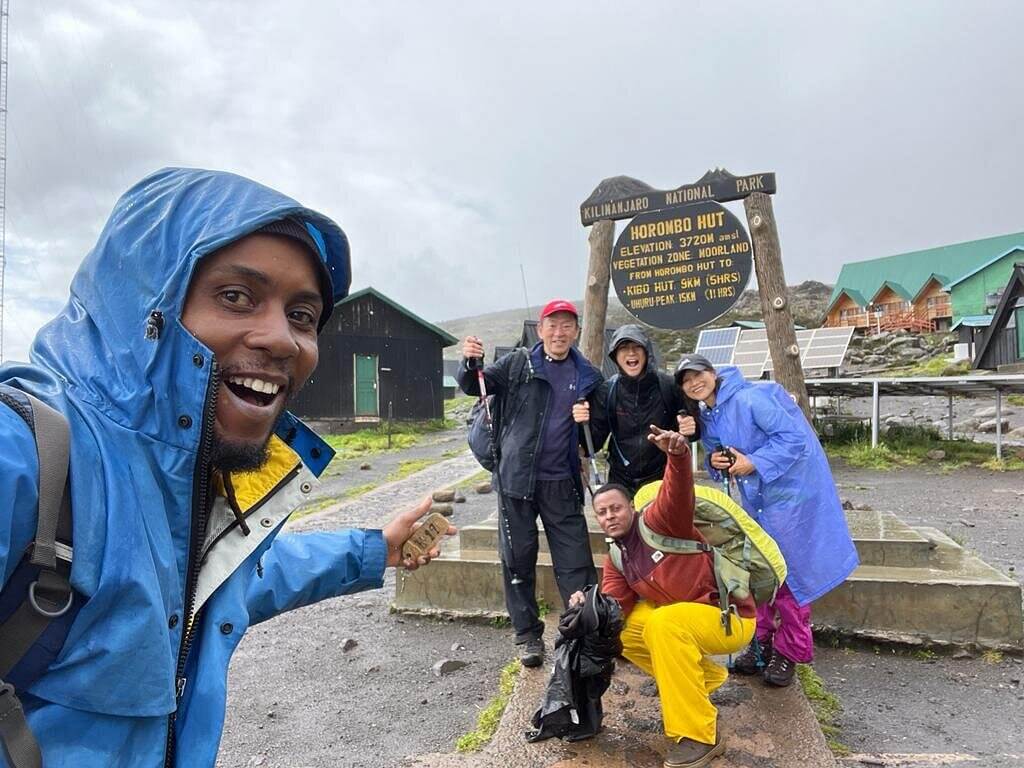
Facts about Kilimanjaro
Kilimanjaro is Africa’s highest mountain – located 330 km south of the equator and only 270 km from the Indian Ocean in northern Tanzania towards the border with Kenya. Kilimanjaro National Park’s area is 1668 km 2 and the national park (the village of Machame) is about 80 km from Arusha.
The mountain is a dormant volcano with the three peaks; Kibo (Uhuru peak, 5895 m a.s.l.), Mawenzi (5149 m a.s.l.) and Shira (3962 m a.s.l.). “Uhuru” means freedom in Swahili! Kibo was created about 460,000 years ago by a huge volcanic eruption. The most recent volcanic activity on Kibo dates back to the early 19th century. And even today, a strong smell of sulfur still wafts from the Reusch crater. The current glaciers on Kibo are about 11,700 years old, but are now melting at an alarmingly high rate – which worries scientists. It can certainly be about natural fluctuations in the weather conditions, as Kilimanjaro previously had ice-free periods during the course of history that lasted for thousands of years. But the researchers suspect that the greenhouse effect (global warming) and changed weather patterns (reduced rainfall amounts) due to deforestation around Kilimanjaro’s slopes are now hastening the melting. Today, just over 2 km 2 of the glacier cover remains on Kibo and that is a reduction of approx. 85% in just 100 years (in the last 25 years the surface and height of the glaciers have decreased by no less than a third). Some researchers now believe that Kilimanjaro’s glaciers, sadly enough, may have completely disappeared already within 10–20 years.
Rainy periods
Kilimanjaro has two annual rainfall periods – the shorter one with lighter rains in November and the longer one with heavier rains in April and May. It is possible to climb Kilimanjaro even during these months of the year, but for obvious reasons it is far from optimal due to limited visibility, muddy paths, risk of slipping and, not infrequently, snow flurries at the top. of Kilimanjaro
Best time to climb Kilimanjaro
The two best periods for trekking on Kilimanjaro are in January–March and July–October respectively. During the period January–March, it is colder and there is a greater chance that the summit is covered with snow. Morning, forenoon and evening/night are usually clear, sometimes followed by an afternoon shower. During the summer and autumn, the weather is somewhat warmer and the sun usually shines from a clear blue sky when you get above 3000 meters (below, however, the cloud cover often spreads out during the day). At an altitude of 4,000 meters, the daytime temperature is usually plus 10–15 degrees C, but drops to minus degrees at night. The average temperature at the top (Uhuru Peak) is minus 7 degrees, but with the wind factor it can be significantly colder. Although it often rains and is gray cloudy weather in December, especially during the afternoons, most hikers visit the mountain during this month. Annually, about 40,000 people climb Kilimanjaro, of which 15,000 choose the Machame trail and 15,000 follow the Marangu trail.
Preparations
To succeed in climbing Kilimanjaro’s top (Uhuru Peak), you should train as much as possible before you leave for Tanzania. Feel free to buy your hiking boots a couple of months before your Kilimanjaro hike so that you have time to break in the boots properly to avoid annoying chafing.
Before climbing Kilimanjaro, it may be a good idea to have a simple medical examination. People with e.g. anemia, heart problems, angina pectoris or limited lung functionality must avoid exposing themselves to the risks that the high altitude of Kilimanjaro can cause.
Remember that preparation is key to a successful Kilimanjaro expedition. Also check the terms of the travel insurance with your insurance company.
Clothing on Kilimanjaro
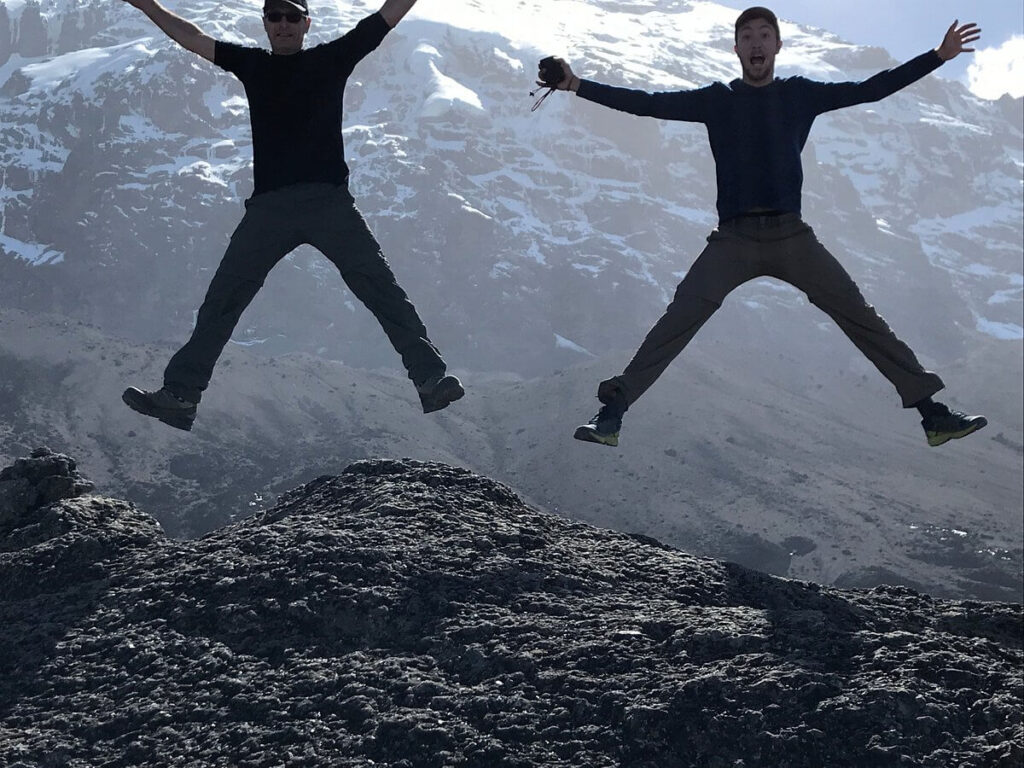
The correct clothing on a Kilimanjaro hike is to follow the multi-layer principle. In other words, when it gets cold, you just add another layer of clothes, therefore remember that the clothes must be the right size so that you can put them on top of each other, and don’t forget that it must be windproof at the end. Your ascent of Kilimanjaro will go from subtropical climate to Swedish winter. See equipment list for Kilimanjaro trek . Your porters who help you carry your pack up Kilimanjaro carry a maximum of 15 kg per day.
Number of guides and porters
The table shows how many personnel come on a Kilimanjaro expedition. The number of staff cannot be reduced, as it is requirements from TANAPA (Tanzania National Parks) that form the basis for the number.
| Number of hikers | Licensed guides | Assistant guide | Chef | Carrier |
| 1 | 1 | 0 | 1 | 4 |
| 2 | 1 | 1 | 1 | 6 |
| 3 | 2 | 1 | 1 | 8 |
| 4 | 2 | 1 | 1 | 10 |
| 5 | 2 | 2 | 1 | 16 |
| 6 | 2 | 2 | 1 | 16 |
| 7 | 2 | 1 | 1 | 20 |
| 8 | 3 | 3 | 1 | 22 |
| 9 | 3 | 3 | 1 | 29 |
| 10 | 3 | 3 | 1 | 30 |
Questions
Feel free to call and ask us more about your planned Kilimanjaro trip. We are happy to share our experiences from our own expeditions on the roof of Africa “Kilimanjaro”
Frequently Asked Questions
What makes Kilimanjaro different from other mountains?
Mount Kilimanjaro stands out because it’s the highest free, standing mountain in the world, rising dramatically from the surrounding plains. Unlike many famous peaks, it doesn’t require technical climbing skills, making it accessible to a wide range of adventurers. What really makes it special is the variety of landscapes you pass through, from rainforest to alpine desert to icy summit. The rapid change in scenery feels like traveling across different climates in just a few days. It’s a unique combination of challenge, beauty, and personal achievement.
Which route should I choose for my climb?
Choosing the right route on Mount Kilimanjaro depends on your fitness level, experience, and how much time you have. Popular routes like Machame and Lemosho offer great scenery and good acclimatization profiles. The Marangu route is often considered easier because it has hut accommodations, but it can be less scenic and more crowded. Longer routes generally give you a better chance of reaching the summit successfully. It’s always a good idea to discuss options with a trusted tour operator before deciding.
How should I prepare physically and mentally?
Preparing for Mount Kilimanjaro involves both physical training and mental readiness. Regular hiking, cardio workouts, and strength training will help build endurance for long trekking days. It’s also helpful to practice hiking with a backpack to simulate real conditions. Mentally, you need patience and determination, especially when dealing with altitude and fatigue. Staying positive and taking things one step at a time can make a big difference.
What kind of support will I have during the climb?
When climbing Mount Kilimanjaro, you’ll be supported by a professional team that usually includes guides, porters, and a cook. Guides are trained to monitor your health, manage the pace, and ensure your safety throughout the trek. Porters carry your main gear, set up camps, and make the journey more comfortable. Meals are prepared for you, often surprisingly good considering the remote environment. This strong support system allows you to focus on the experience rather than logistics.
What happens after reaching the summit?
Reaching the summit of Mount Kilimanjaro is an incredible achievement, but the journey doesn’t end there. After celebrating at Uhuru Peak, you’ll begin your descent, which is usually faster but still requires care. Many climbers feel a mix of joy, relief, and exhaustion as they head down. Once back at the base, it’s common to celebrate with your team and reflect on the experience. For many, it becomes a life, changing adventure they will always remember.
Still have questions?
Our local safari experts are happy to help you plan the perfect African safari.


