
By Angeline Lizzie Gavaza – Zimbabwean – Extract from the book Dreamers & Doers.
I ask myself, how can someone dream of trekking for spiritual fulfillment if they have nowhere to lay their head at night? How can one dream of climbing Kilimanjaro when they are not able to educate themselves? How can one dream of climbing the mountain, even the mountain in one’s own continent, when one is living hand-to-mouth?
We live in a world that can be cruel. Millions of children in Africa die before they even have a chance to live the life a child was meant to live – a life free of poverty, a life free from exploitation, a life free from child labour, a life free from prostitution, a life free from the burden of disease. 3 Thirtyseven is my opportunity to give back, to make a difference even if in a very small way, to children in need in Zimbabwe, my country of heritage.
I asked myself, what is my purpose on this earth? I am a proud African woman of Zimbabwean heritage, and my mission in life is to leave a legacy of hope for Africa. I was born and spent my childhood in Harare, Zimbabwe before pursuing a nursing career in London, my adopted second home.
I came up with an idea. To bring professional African women together by organising a climb to Kilimanjaro on behalf of our chosen charities from our African country of heritage. In 2011, with two close friends of African heritage, I founded a non-profit organisation to bring my dream to life. Nothing like this had ever been done before – we would be making history. African women, on African soil, for an African cause! I decided to name the company 3 Thirtyseven, after the co-ordinates of Kilimanjaro, symbolic of where the vision was born. Mount Kilimanjaro lies 3 degrees South of the equator and 37 degrees East.
Teaming up each year with regulated tour operators, 3 Thirtyseven seeks to encourage professional and enterprising women living anywhere in the world to fundraise for a charity of their choice from their African country of heritage by taking part in annual outdoor challenges. Self-funding their own Kilimanjaro challenge meant that 100% of all funds raised would go to their chosen African charity. What better outdoor challenge was there than to climb Kilimanjaro, the highest free-standing mountain in the world, the highest mountain in Africa? None!
For my personal Kilimanjaro challenge, I chose Ndoro Children’s Charity, dedicated to supporting underprivileged children in the poorest parts of the world. It has many projects to help poor children in Zimbabwe, South Africa and Ghana. One of their main projects is building Zororo Leadership Academy, a home and school for a small group of orphans in rural Zimbabwe.
Taking on the Kilimanjaro challenge is my metaphor for overcoming adversity and relishing challenges in my everyday life at zero altitude with dignity, resilience, tenacity and focus. For an ordinary African woman to face Kilimanjaro is a testimony that with adequate physical training, proper gear and belief in oneself, anyone can overcome the most monumental challenge.
The training discipline itself was the first challenge. I was determined to be prepared physically, and so for ten months I in heavy snow, rain and heatwaves. Juggling the demands of 3 Thirtyseven, training, family commitments and working full-time as a nurse in London was a huge undertaking. But I had a legacy to leave for my beloved continent of Africa. I want my nephews to know and understand what their aunt had achieved with 3 Thirtyseven, and to inspire them to believe in themselves.
The journey to the roof of Africa was nothing short of incredible. There is so much more to Kilimanjaro than her summit. As a female black African adventurer – from my personal experience of being on a few mountains or merely exploring the world – I have encouraged others to challenge stereotypes. When I was climbing Kilimanjaro I encountered the greatest variety of nationalities I’ve ever found in any other single travel endeavour. Yet the common spirituality of enjoying Kilimanjaro in our rainbow of diversity as human beings was an intense experience which I will always treasure.
Summit night was very touching. The labour of the porters and their love of their mountain was deeply moving. In my eyes, the real heroes of the mountain are the porters who labour passionately to ensure that those who come from near or far enjoy the beauty of Kilimanjaro.
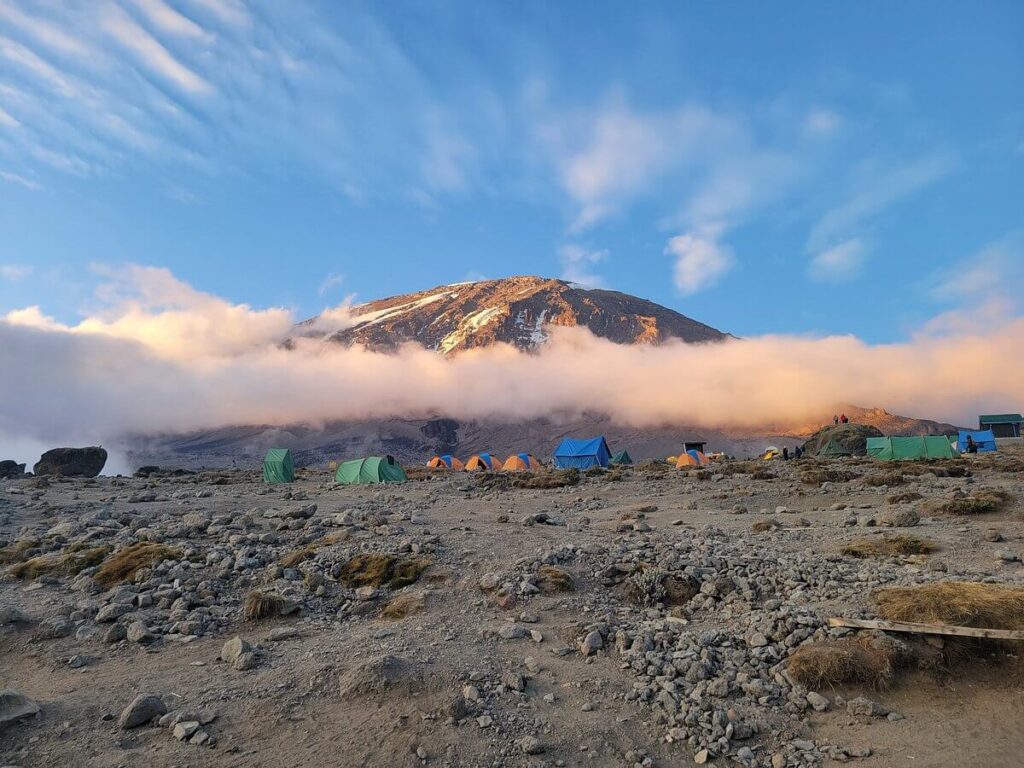
Without a doubt, reaching the summit I felt an indescribable, extraordinary sense of elation, but also of profound sadness for all the inequalities in the world; that children live in poverty. It wasn’t touching the soil on Uhuru Peak after walking for six days via the Machame route which meant more to me. What meant more was the journey to the mountain which began with that little idea I had had four years before. What it took to be on that mountain, to enjoy the surreal beauty of climbing Kilimanjaro for Ndoro Children’s Charity, is my testament of my hope for a better Africa. I am proud to say that I fundraised 567 English pounds (670 euros) online via JustGiving. I am even more proud that on the 12th September 2012, four professional women of African heritage representing Malawi, South Africa and Zimbabwe reached Stella Point and Uhuru Peak.
My journey to the “Roof of Africa” was a deeply humbling experience. My appreciation for the simple things in life was re-ignited. Living in the West, one can often take for granted the important basics required for human survival, such as instant access to clean water. And now I am doing my little part in making a difference to others lives.
Frequently Asked Questions
What does “zero altitude” symbolize when talking about adversity?
“Zero altitude” is a way of describing those moments when you feel completely stuck or at your lowest point. It’s not about mountains or height, but about emotional and mental space. You might feel like you have no momentum, no direction, and no energy to move forward. It’s a place many people experience at some point in life. The important thing is recognizing that being at zero doesn’t mean you can’t rise again.
How do you start moving forward when you feel stuck at rock bottom?
Starting small is often the most realistic way to begin. You don’t need a big breakthrough, just one small step in the right direction. It could be reaching out to someone, setting a tiny goal, or simply getting through the day. Progress at this stage is slow, but it still counts. Over time, those small steps begin to build momentum.
What mindset helps when facing everyday struggles?
A mindset of patience and self, compassion can make a big difference. Instead of being harsh on yourself, it helps to accept that growth takes time. Focusing on what you can control, rather than what you can’t, also reduces stress. It’s about shifting from “why is this happening to me?” to “what can I do next?” That small shift can open the door to new possibilities.
How can people find strength when they feel like they have none left?
Strength doesn’t always feel like strength, it often looks like simply not giving up. Even getting out of bed or facing the day can be an act of courage. Support from others, whether friends or family, can help you see your strength when you can’t feel it. Sometimes reflecting on past challenges you’ve overcome can remind you of your resilience. Bit by bit, that strength begins to rebuild itself.
Why is overcoming small struggles just as important as big victories?
Small struggles shape your character in ways big victories often don’t. They teach patience, humility, and persistence. While they may not feel significant at the time, they build the foundation for bigger achievements later. Every small win proves that you’re capable of progress. In the end, it’s those everyday victories that truly define your journey.
Still have questions?
Our local safari experts are happy to help you plan the perfect African safari.


