Tourcode:KA-EN-003
Price
| Price | 2 Adults | 4 Adults | 6 Adults |
|---|---|---|---|
| Price per Person | $ 4253 | $ 3987 | $ 3790 |
The tour price includes everything except international flights, visas, and travel insurance. Accommodation is based on standard/midrange options, with flexibility to upgrade or downgrade to match your budget and style. Click the button below to book or customize this tour. Our experts will be ready to help you tailor your perfect journey.Book this Trek Now
Itinerary Details
-
- Tour Highlights
- Arrival Day
- Day 1 :Moshi Town to Londorossi Gate
- Day 2: Mti Mkubwa Camp to Shira Camp 1
- Day 3:Shira Camp 1 to Shira Camp 2
- Day 4:Shira Camp 2 to Moir Camp
- Day 5:Moir Camp to Buffalo Camp
- Day 6:Buffalo Camp to Third Cave
- Day 7:Third Cave Camp to School Hut Camp
- Day 8:School Hut Camp to UHURU PEAK and to Crater Camp
- Day 9:Crater Camp to Mweka Camp
- Day 10:Mweka Camp to Mweka Gate
- Departure Day
- TREK INCLUDES
- TREK EXCLUDES
- General Frequenlty Asked Questions About Mt. Kilimanjaro Trekking
Kilimanjaro northern circuit route is often covered in ice or snow, which make the most scenic route up to Kilimanjaro. Many trekkers who attempt it admit that is has high and proper acclimatization due to the number of days spending on the trekking. Approaching the mountain from the west side Northern circuit until this recently has been considered as a technical mountaineering route. It gained its popularity after other routes of Machame and Lemosho being crowded. Whenever you want to go for this route make sure you are experienced with mountains and properly equipped especially with the right clothing. Make sure you look for a reputable tour operator to arrange this kind of tour for you.
Tour Highlights
- You will hike for seven days to the summit of Mount Kilimanjaro.
- To avoid problems, always listen to your guide whatever is saying.
- While walking you will experience five different climates and vegetation zones
- A great route with favorable weather and the capacity to reach the summit with a high success rate.
- When you reach the top of the clouds, you will be treated to a breathtakingly and unusual sight.
Arrival Day
Once arrived at Kilimanjaro International airport (JRO), our driver guide from Kilimanjaro ASAP will pick you up from the airport arrival gate and then drive you to the Hotel in Moshi town. Once in the Hotel, our Kilimanjaro mountain guide will meet and pre-briefing you about your upcoming trek adventure as well as check if you have all the necessary mountain gear, unless you do not have some of the equipment then you can rent before starting the trek.
- Time: 1 Hour Drive
- Distance: 47km
- Accommodation: Panama Garden Resort
- Meals: B,
Day 1 :Moshi Town to Londorossi Gate
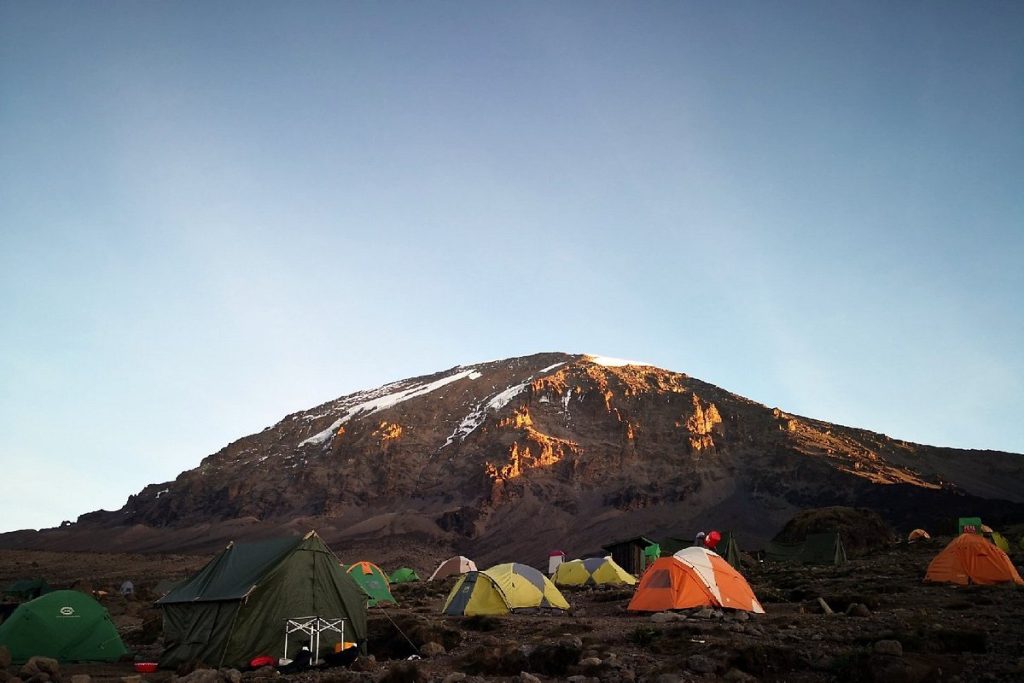
When you arrive at the Lemosho gate, you will register your names and show your passport before entering the Kilimanjaro National Park and beginning your journey. Mti Mkubwa Camp (2,895 m), also known as Big Tree Camp, is a three-hour walk from the gate. When you arrive at your camp, there will be hot water for you to wash your feet and the tent will be ready for you to sleep, as this is your first night inside the Kilimanjaro National Park.
- Time: 3-4 Hours
- Distance: 6km
- Habitat: Montane Forest
- Elevation: 2,360m to 2,895m
- Accommodation: Camping
- Meals: B, L, D
Day 2: Mti Mkubwa Camp to Shira Camp 1
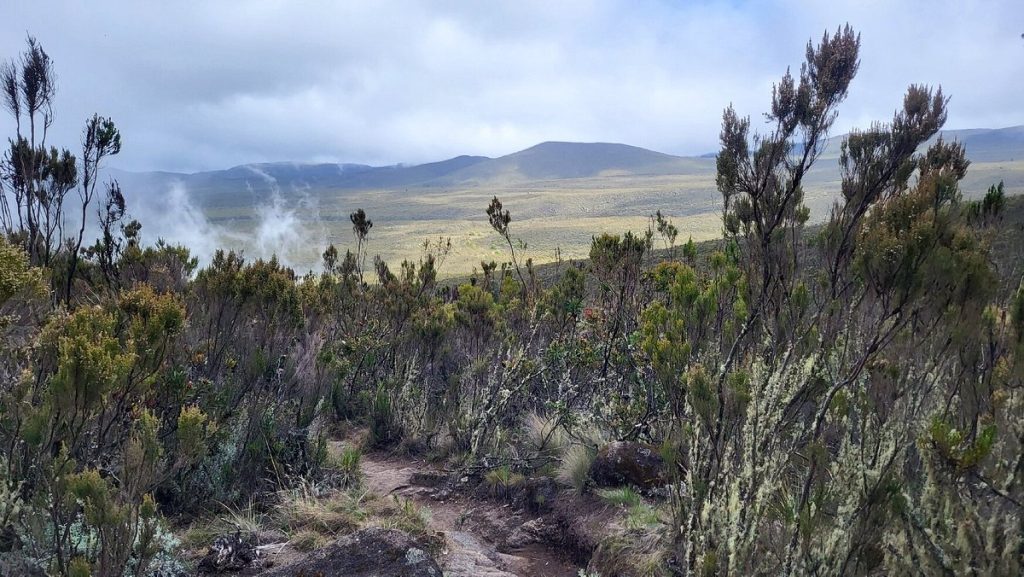
After breakfast, you will walk for about five to six hours towards Shira 1 camp, leaving behind the natural forest with animals such as black and white colobus monkeys and entering the heather and moorland zone. On your way to Shira 1 Camp (3,505 meters), you will cross small rivers. Shira is a beautiful area with breathtakingly mountain views and you will spend a night here.
- Time: 4-6 Hours
- Distance: 8km
- Habitat: Montane Forest/ Moorland
- Elevation: 2,895m to 3,505m
- Accommodation: Camping
Day 3:Shira Camp 1 to Shira Camp 2
Today will trek through the moorland vegetation before trekking the zone of giant heather and reaching Shira Plateau which is one of the longest plateaus on earth after a short trek we will then arrive at the camping area which is Shira 2 where you will spend a night. At the campsite, you can spot the Western Breach if the weather permits.
- Time: 4-6 Hours
- Distance: 6.9 km/4.5 miles
- Habitat: Heath
- Elevation: 11,496 ft to 12,779 ft
- Accommodation: Camping
- Meals: B, L, D
Day 4:Shira Camp 2 to Moir Camp
From Shira Campsite you will cross the valley and trek for about 4 hours or so and reach the Lava tower (4600 meters) where you can have your lunch. Today is an important day for your body acclimatization. Later we will trek down to a low-altitude camp, Moir Hut, (4200m) which is rarely used by many trekkers. Relax enjoy the view and have a nice dinner in the evening at the campsite, the base of Lent hills.
- Time: 4-5 Hours
- Distance: 8km
- Habitat: Heath/ Alpine Desert
- Elevation: 3,840m to 4200 m
- Accommodation: Camping
- Meals: B, L, D
Day 5:Moir Camp to Buffalo Camp
From Moir camp, we will continue up the steep ridge and have an option to trek the Lent hills (4700m) before continuing with the main trail which crosses the valley up and down, and then arriving at our campsite, Buffalo camp which is located close to the Kenyan border at 4000m above sea level. Enjoy your dinner and nice views of the stars.
- Time: 4-5 Hours
- Distance: 8km
- Habitat: Heath/ Alpine Desert
- Elevation: 4200 m to 4000 m
- Accommodation: Camping
- Meals: B, L, D
Day 6:Buffalo Camp to Third Cave
Coming from Buffalo camp today you will trek through the alpine desert and cross the Buffalo ridge. At noon we will have lunch at Pofu camp and then head the eastern side of the mountain up and down, then into a little gorge and up again to the Third Cave (3800m). You will rest and get ready for your dinner.
- Time: 4-5 Hours
- Distance: 5 km/3 miles
- Habitat: Alpine Desert
- Elevation: 4000 m to 3800 m
- Accommodation: Camping
- Meals: B, L, D
Day 7:Third Cave Camp to School Hut Camp
Today after breakfast we will trek up the steep ridge with the high-altitude alpine desert vegetation then up again and emerge into a superb view of Kibo and Mawenzi peak than to the School Hut (4800m). Once arrived at the School Hut camp which can be extremely cold then you will have your early dinner and then go for a pre-summit sleep in the night which you can start around 11 to 12 am.Above 4000m the vegetation is alpine desert and you will be able to witness only White-necked ravens going around the campsite. Not so much while arriving at the School Hut camp. No water for a wash. No water streams above this elevation. By the time you arrive, you will be tired and maybe weak. The crew will already set up your tent as well as a table for dinner (you won’t feel sleepy anyway). Your guide will visit you before hitting the bed for checking on your required summit clothes. It advised sleeping on 3 layers of clothes. First, it is cold at the base camp during the night (up to -10c). Second, it is because you have to make your layers warm as you will leave at midnight for the summit which is the exact cold. You will have your early dinner and then go for a pre-summit sleep until around 11 to 12 a.m. before start trekking to Uhuru Peak
- Time: 4-5 Hours
- Distance: 4 km/2 miles
- Habitat: Alpine Desert
- Elevation: 3800m to 4800m
- Accommodation: Camping
- Meals: B, L, D
Day 8:School Hut Camp to UHURU PEAK and to Crater Camp
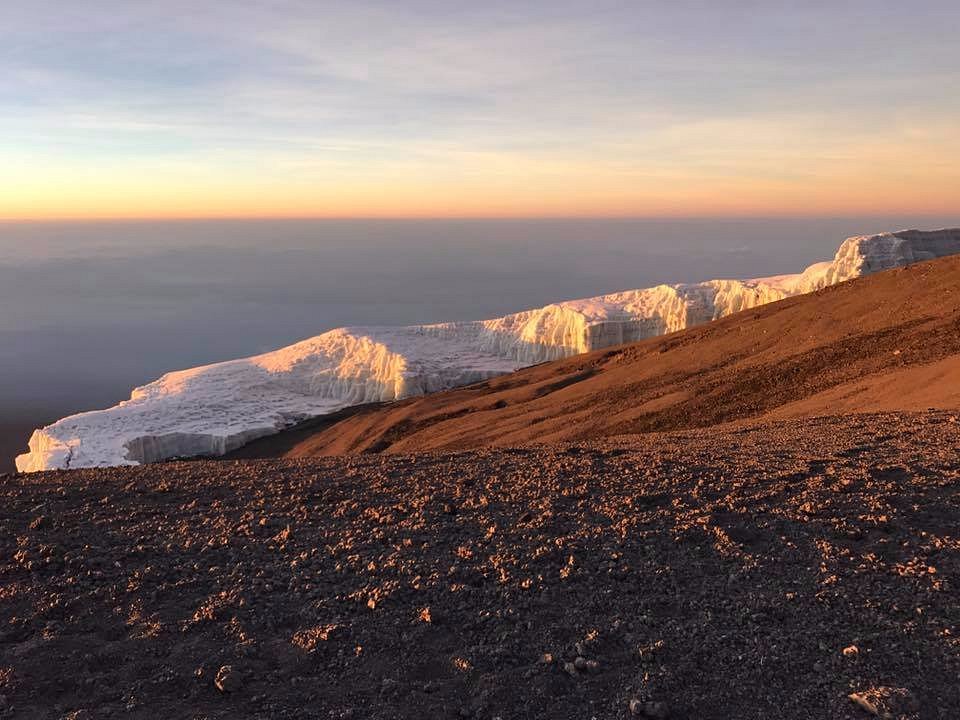
Before leaving for Uhuru Peak, you will have a cup of coffee and cookies or biscuits. Put on the rest of the layers (summit clothes) and be ready to conquer Mount Kilimanjaro (Uhuru Peak). What an incredible trek. Temperatures at the top of Mount Kilimanjaro, the nights are really cold. In the middle of June, the thermometer can drop to – 20 C. Dress and cover yourself accordingly. Walk slowly and listen to your Guide’s instructions. Expert to take six to seven hours from Barafu to Uhuru peak, the highest point in Africa, once at Uhuru peak you will be amazed by the breathtakingly views and incredible sunrise if the weather permits.After having fun at the top of Africa, we will descend to a unique and incredible camp for those who love adventure when climbing Mount Kilimanjaro, known as the crater camp, where you will undoubtedly find your belongings and sleeping tent already prepared by the group you accompanied from the start. If you visit this camp, you can see the famous glacier known as the Walter Furtwängler and Siegfried König Glacier, which they discovered in 1912, or you can see the Reusch crater, which was named in 1954 to honour Gustav Otto Richard Reusch by the Tanzanian government. The Ash Pit, which has a depth of 1200 feet, can be seen from the Reusch crater. Be close to your guide in this camp so that he is aware of your health status. Because this is the highest camp on Mount Kilimanjaro, the weather can change at any time and bring you a health challenge such as altitude mountain sickness. Enjoy the benefits of this one-of-a-kind camp.
- Time: 8-10 Hours
- Distance: 14 km
- Habitat: Ice-capped summit
- Elevation: 4,754m to 5,895m Ascent
- Elevation: 5,895m to 5,750m Descent
- Accommodation: Camping
- Meals: B, L, D
Day 9:Crater Camp to Mweka Camp
After breakfast in the morning, you will then descend down to Mweka camp and make a lunch stop at Barafu Camp. Many people do not explain the difficulty of descending Mount Kilimanjaro, but it can be difficult, especially on the knees, if you do not have trekking poles, so we recommend that you have these poles to make your trip down this rocky path easier. In the evening you will arrive at the last camp on your trip, Mweka camp, here you will rest as you will be very tired and prepare for your last dinner on your trip.
- Time: 6-7 Hours
- Distance: 12 km
- Habitat: Rainforest
- Elevation: 5,750m to 3,640m
- Accommodation: Camping
- Meals: B,
Day 10:Mweka Camp to Mweka Gate
From here you follow a path that follows a gully and later an old logging track which is often very slippery. This track will take you to the tree forest where the Mweka gate is. Expect this leg of the trek to take 4 to 6 hours. Once you arrived you will sign out and get presented with the certificates. The driver-guide will be there to drive you back to the hotel in Moshi Town together with the crew. (Here is when the Tipping celebration can take place). Then you can go back to the Hotel and get ready for your flight back home or to Zanzibar or prepare for the safari trip the next day. Contact us for more details.
- Time: 3-5 Hours
- Distance: 9 km
- Habitat: Rain forest
- Elevation: 3,640m to 1,640m
- Accommodation: Panama Garden Resort
- Meals: B,
Departure Day
After breakfast in the hotel depending on your flight time you can have time to explore or relax and wait for your transfer to Kilimanjaro Airport for your departure flight back home or continue with your holiday with wildlife Safari tour or go relax on Zanzibar Island Beaches. Contact us for more details.
- Transport: Minibus
- Meals: B, (Breakfast)
- Activity: Airport Transfer
TREK INCLUDES
- Transfers to/from Kilimanjaro International Airport
- All accommodation in Tanzania including breakfast (one nights before and one night after your climb-two nights total)
- Kilimanjaro National Park entrance, camping, and rescue fees
- Services of trip leader, climbing guides and mountain crew
- All dining and camping equipment (excluding sleeping bag unless rented)
- Double layered sleeping mats
- 4 Season Mountain Tents
- All meals on the mountain
- 18% VAT on tour fees & services
- Hot water for washing after arriving at the camp
- Porters to carry luggage with a maximum weight of 20kg
- Local and Friendly English-speaking Mountain Guide
- All Porters, Guides, and Cook Fees and Fair Wages as Recommended by KPAP and KINAPA
- Government Taxes
- Filtered water during the climb; tea, coffee, cocoa, milk and juices as required.
- Clean Mountain Can used to remove all waste from high camps for correct disposal.
- Safety Equipment:
- First aid kit
- Pulse Oximeter
- Emergency Oxygen
- Medsled Rescue stretcher
- Personal Summit Certificate signed by the National Park for successful trekkers
TREK EXCLUDES
- Costs of visas
- Immunizations
- International airfare, excess baggage charges, airport departure taxes
- Travel insurance, medical insurance
- Portable private toilet with biodegradable waste system at all camps
- Sightseeing, game drives or meals not listed in each itinerary
- Personal expenses such as beverages (other than those included with meals, as listed in each itinerary), room service, souvenirs, laundry, communication charges, medical or extra evacuation fees, staff gratuities.
- Additional transportation, accommodation, and meals incurred by a client unable to continue a planned itinerary due to illness, health, medical conditions or due to airline schedule change
- Tipping the Team per group/climber per day
Guides: US$ 20-30 per day. Cook: US$15-25 per day. Porter: US$10-20 per day
General Frequenlty Asked Questions About Mt. Kilimanjaro Trekking
In what way is Kilimanjaro ASAP a reliable provider of Kilimanjaro treks?
Kilimanjaro ASAP has many years of experience organising Kilimanjaro expeditions. Our team has extensive knowledge of the mountain, gained through firsthand experience completing climbs and working on Kilimanjaro. We also offer some of the most competitive prices on the market across our range of trekking packages. Thomas Nyaki, a Tanzanian tourism professional who manages all Kilimanjaro ASAP bookings in Arusha, began his career on Kilimanjaro as a porter before progressing to become a mountain guide. His firsthand experience gives him an in-depth understanding of the mountain, its routes and the challenges climbers may encounter. Over the years, he has also built strong relationships with experienced guides, cooks and porters, enabling Kilimanjaro ASAP to select reliable and skilled mountain crews for our expeditions. This combination of local expertise, personal experience and trusted professional relationships is a valuable asset and provides our customers with greater confidence, security and peace of mind throughout their Kilimanjaro adventure.
What is included in the Kilimanjaro ASAP Kilimanjaro trekking package?
The packages covering 6 or 7 hiking days on the mountain include airport pick-up and drop-off in Arusha upon arrival and departure, as well as budget hotel accommodation in Arusha for the night before and the night after the hike. The packages also include national park and camping fees, rescue fees in case you are forced to interrupt the climb, transport to and from Kilimanjaro, and all the personnel required to make the expedition possible, including guides, assistant guides, a cook and porters. Full board is provided during the hiking days, including drinks such as water, tea, coffee and juice. It is easier to explain what is not included: lunch and dinner at the hotel in Arusha, where accommodation is provided on a bed-and-breakfast basis. The only additional cost after completing the hike is the tips for the mountain crew. Please read more about tipping under the separate tab further down the page.
What kind of hotel do you stay at in Arusha before the Kilimanjaro hike?
The Kilimanjaro ASAP standard package includes accommodation at the centrally located budget hotel, Green Mountain Hotel. We have chosen this simple budget hotel to keep costs down. The hotel staff take excellent care of all the hikers who book with Kilimanjaro ASAP every year. The rooms are of a simple standard without a TV, but they are clean and have hot water in the shower. For travellers who prefer more luxurious accommodation, it is of course possible to upgrade at an additional cost. In that case, Kibo Palace Hotel is highly recommended, or, for an even higher level of comfort, we can suggest the Gran Meliá Hotel, for example.
Can I add one or more nights at a hotel in Arusha before or after the Kilimanjaro hike?
Yes, it is perfectly possible to do so. In fact, many of our hikers, especially those arriving late in the evening or during the night in Arusha, choose not to start the hike immediately the following day. Instead, they spend an extra day relaxing in Arusha and begin the climb after two overnight stays. There are several advantages to this. First, it can be nice to have some time to relax and unwind before the hike, especially after a potentially intensive period of work at home. Additionally, since Arusha is located at approximately 1,300 metres above sea level, spending a couple of days here may allow some initial adjustment to the altitude before beginning the climb.
Do you sell Kilimanjaro hikes that also include regular flights down to Tanzania?
Kilimanjaro ASAP leaves it up to customers to book their own scheduled flights. There are several advantages to this arrangement. First, you can choose your preferred travel dates and decide exactly when you would like to begin your Kilimanjaro hike. Booking your own flights can also be cheaper, as prices vary considerably depending on departure dates, the time of year, airlines, departure times and travel duration.
The easiest way to find suitable flights is to use a flight search engine such as Flygresor, Reseguiden or Momondo. Simply search for departures from your preferred airport, with Kilimanjaro International Airport (JRO), located near Arusha in Tanzania, as your final destination.
Some travellers choose to fly to Nairobi in Kenya instead, as flights can sometimes be cheaper. From Nairobi, you can take a bus to Arusha, with the journey taking approximately five hours. Riverside Shuttle is one option to consider. Bus services and departure times may vary, so we recommend checking the current schedule and booking your seat in advance.
Many travellers also choose to continue their holiday in Zanzibar after climbing Kilimanjaro. In this case, you will need to arrange a domestic flight from Kilimanjaro International Airport (JRO) or Arusha Airport (ARK) to Abeid Amani Karume International Airport (ZNZ), near Stone Town in Zanzibar. The flight takes approximately one hour to one hour and fifteen minutes, depending on the route and airline. Booking domestic flights in advance is generally advisable, as prices and availability can change.
Your return journey to Sweden can be arranged from Kilimanjaro International Airport (JRO), Zanzibar (ZNZ), Dar es Salaam (DAR) or Nairobi (NBO), depending on your itinerary and flight connections.
The airlines commonly used for travel from Sweden to Tanzania include Ethiopian Airlines, Qatar Airways, KLM, Kenya Airways, Turkish Airlines and Egyptair. All offer international connections, but prices, departure and arrival times, stopovers and total travel duration vary. We therefore recommend comparing the available options to find the flights that best suit your travel plans and budget.
How do we book a Kilimanjaro hike with Kilimanjaro ASAP?
After going through these FAQs, we hope that many of your questions about climbing Kilimanjaro have been answered. Kilimanjaro ASAP is usually contacted by email at trek@kilimanjaroasap.com, after which we send information about Kilimanjaro, safari trips and/or Zanzibar, according to each customer’s wishes. After reading through the information provided, additional questions will probably arise. We will be happy to answer these by email or telephone, almost always with very short waiting times. We will assist you with all the information you need to plan your Kilimanjaro hike until the final travel arrangements have been agreed upon and you are ready to book. Once you have booked your scheduled flights and have your flight numbers and arrival and departure times, it is time to book your Kilimanjaro hike, along with any additional safari package and/or stay in Zanzibar. Kilimanjaro ASAP will then prepare a travel agreement with a detailed description of your travel arrangements, the relevant dates and any other agreed details. To prepare the agreement, we will need the travellers’ full names, personal identification details, contact addresses and telephone numbers. The travel agreement will also include information about the payment procedure. Once the customer has paid 50% of the total cost of the booked travel arrangements, our team in Arusha will proceed with completing all the necessary bookings. As confirmation of the payment, it is important that the customer sends a screenshot of the payment receipt to trek@kilimanjaroasap.com. Please note that it usually takes 5–7 days for a payment to be credited to our KCB bank account in Tanzania.
How far in advance do we need to book the Kilimanjaro trek?
Unlike safari bookings and/or stays in Zanzibar, where it may be necessary to make reservations well in advance to secure available rooms, especially during the Christmas and New Year period, a Kilimanjaro hike can often be booked at relatively short notice before departure. However, this flexibility mainly applies to routes that offer camping on the mountain, such as Machame, Rongai and Lemosho. If you wish to climb via the Marangu Route, where accommodation is provided in mountain huts, you should make your reservation well in advance, preferably 3–6 months before departure. This is particularly important during the busy Christmas and New Year period.
How much does it cost to climb Kilimanjaro?
Machame Trail or Marangu Trail (6 days): US$1,950 (price 2026) per person. Rongai Trail (6 days): US$2,350 (price 2026) per person. Machame/Umbwe Trail (6 days): US$2,250 (price 2026) per person. Machame Trail (7 days): US$2,350 (price 2026) per person. Lemosho Trail (7 days): US$2,450 (price 2026) per person. All of the above prices are for groups of 2 or more. If you are travelling alone, there is an additional cost of US$450, regardless of the trail.
Why is it so expensive to climb Kilimanjaro?
Many people are surprised by how expensive it is to climb Kilimanjaro. After all, how can it cost so much just to walk up a mountain? The reality is that Tanzania, as a developing country, has learned to charge substantial fees for its world-famous and highly sought-after destinations. The total cost reflects national park and camping fees, staff salaries, tents and other equipment, food, transport and many other expenses. Once all these costs have been covered, tour operators are often left with relatively small profit margins. It is understandable that the price may feel high, especially when tips are added on top. However, you can take comfort in the fact that climbing Kilimanjaro is an adventure that many people experience only once in their lifetime. The incredible feeling of descending the mountain on tired legs after reaching Uhuru Peak, the highest point in Africa, makes both the physical effort and the financial investment worthwhile.
Explain what this “thin air” means on Kilimanjaro?
A common misconception is that the air becomes thinner as you climb higher on a mountain. In reality, the composition of the air remains relatively constant throughout the troposphere, the lowest layer of Earth’s atmosphere, which extends approximately 8–18 km above the Earth’s surface depending on latitude and season. The air contains about 21% oxygen and 78% nitrogen, regardless of altitude. In other words, the proportion of oxygen remains essentially the same whether you are at sea level or standing on Uhuru Peak. However, this does not mean that oxygen availability is the same at all altitudes. Atmospheric pressure decreases as you climb, meaning that the air pressure at the summit of Kilimanjaro is only around 40% of that at sea level. As a result, each breath delivers considerably less oxygen to your lungs and bloodstream. Above 5,000 metres, the amount of oxygen available with each breath is roughly half what you would experience at sea level in cities such as Stockholm, Gothenburg or Malmö. This reduced oxygen availability is one of the main challenges of climbing Kilimanjaro and explains why proper acclimatisation is essential.
How big is the risk of getting altitude sickness on Kilimanjaro?
Most hikers on Kilimanjaro may experience some symptoms of acute mountain sickness (AMS) as a result of the high altitude and reduced air pressure. Mild symptoms can include headaches, nausea, dizziness, fatigue and difficulty sleeping. These symptoms should never be ignored, even if they are relatively common during a high-altitude trek. Taking regular breaks and walking slowly can help you manage the physical demands of the climb, but rest alone does not guarantee that altitude sickness will improve. It is essential to monitor your condition continuously and inform your guide immediately if you develop any symptoms. Severe altitude sickness can be life-threatening. If symptoms worsen or signs of severe altitude illness develop, the climb must be stopped and you must descend to a lower altitude as quickly and safely as possible, even if this means descending at night. Your safety must always come before reaching the summit.
What is altitude sickness? What are the symptoms?
It is a well-established fact that all the body’s organs and muscles need oxygen to function properly. At high altitudes, reduced oxygen availability can affect the brain and other vital organs, potentially leading to serious and even life-threatening complications. Fortunately, the body begins adapting to high altitude by breathing deeper and faster and increasing the heart rate. Over the following days, further adaptations occur, including an increase in red blood cell production. However, since a Kilimanjaro expedition usually lasts only a few days, there may not be enough time for the body to acclimatise adequately. Furthermore, people differ considerably in how well and how quickly they adapt to high altitude. When the body cannot adjust sufficiently to the reduced oxygen availability, altitude sickness can develop. The medical term is acute mountain sickness (AMS), which is commonly described as mild, moderate or severe. Mild AMS can resemble a hangover, with symptoms such as a persistent or throbbing headache, nausea, fatigue, difficulty sleeping and loss of appetite. Although painkillers may relieve a headache, they do not treat the underlying altitude problem and can mask an important warning symptom. Medication should therefore only be used following appropriate medical advice. Moderate AMS may involve worsening headaches, nausea, vomiting and unusual fatigue. Breathing may also become more difficult, and symptoms may not improve with rest. These signs require immediate assessment by the mountain guide. Continuing towards the summit is not recommended when AMS symptoms persist or worsen. Severe altitude sickness is a medical emergency. Warning signs include confusion, difficulty walking straight or maintaining balance (ataxia), reduced alertness, unusual behaviour and difficulty staying awake. Other serious symptoms, such as breathlessness at rest, a persistent cough, coughing up blood or pink frothy sputum, and blue or grey lips, may indicate a life-threatening complication. Two particularly dangerous conditions are high-altitude cerebral oedema (HACE), which involves swelling of the brain, and high-altitude pulmonary oedema (HAPE), which involves fluid accumulation in the lungs. If severe altitude sickness or suspected HACE or HAPE develops, the climb must stop immediately. Urgent descent to a lower altitude and emergency medical assistance are essential. Oxygen and other emergency treatments may also be required. Experienced mountain guides play an important role in monitoring hikers and recognising warning signs early, allowing problems to be addressed before they become more serious. Nevertheless, altitude sickness cannot always be predicted or prevented, even with an experienced team and a carefully planned itinerary. As a hiker, you must communicate openly with your guide about how you feel and report any symptoms, however mild they may seem. If you have any doubts about your condition or your ability to continue, speak to your guide immediately. Your safety must always take priority over reaching the summit.
Is hiking Kilimanjaro dangerous for your health?
It is generally not dangerous to hike Kilimanjaro when you observe the necessary precautions. Everyone should feel safe in the company of the staff on the mountain. The guide always does his utmost to ensure that the hike runs as smoothly as possible. The guides also understand how important it is for hikers to reach Uhuru Peak, and they do everything they can to help you achieve this goal, but never at the expense of your safety. Your health always comes first! Since you walk at a slow, steady pace, drink plenty of fluids, take regular breaks and remain under the constant supervision of an experienced guide, the risk of developing serious altitude sickness that endangers your health or life is relatively low. However, around 10 people die on Kilimanjaro each year, although tourist fatalities are relatively uncommon. Instead, many of the fatalities involve porters, primarily due to inadequate clothing, which can lead to hypothermia, as well as accidents. Hypothermia occurs when the body’s core temperature drops below 35°C. If the body temperature falls to around 30°C, serious complications can occur, potentially leading to cardiac arrest or insufficient oxygen supply to the brain.
What is this altitude acclimatization thing?
Acclimatisation, or getting used to high altitude, occurs when you spend an extended period of time at higher elevations. Elite endurance athletes often take advantage of this by living and training at high altitude for a period before a championship. During these high-altitude training camps, the body has time to produce more red blood cells, which can improve performance. If the championship is also held at high altitude, the body is better adapted to the conditions, reducing the risk of altitude-related problems. Similarly, climbers attempting to summit Mount Everest often spend several weeks at base camp, located at approximately 5,364 metres above sea level, before beginning their final ascent to the summit at 8,849 metres. On Kilimanjaro, gradual acclimatisation takes place as you slowly hike to higher elevations, typically spending several nights on the mountain before attempting to reach Uhuru Peak at 5,895 metres above sea level. An additional acclimatisation day on Kilimanjaro involves temporarily ascending to a higher altitude than the elevation at which you will sleep that night. Along the Machame Route, for example, hikers pass Lava Tower at approximately 4,630 metres above sea level on day three before descending to the Barranco campsite, located at around 3,950 metres. This approach, commonly known as “climb high, sleep low,” helps the body adapt to altitude. You can also practise this technique at other campsites by walking to a slightly higher elevation for around half an hour before returning to camp. However, additional ascents should always follow your guide’s advice and the planned itinerary, as proper acclimatisation depends on the overall ascent profile, adequate rest and individual responses to altitude.
What happens if you get altitude sickness or are forced to cancel your hike on Kilimanjaro?
If the guide determines that a hiker’s health is at risk due to altitude sickness on Kilimanjaro, the decision may be made to end the hike early. When a hike is interrupted, it is important to get the hiker to a lower altitude as quickly and safely as possible. Descending to a lower altitude is one of the most effective ways to help the body recover from altitude-related illness. In most cases, a hiker who is forced to abandon the climb can descend on foot. However, if their condition is more serious and they are unable to walk independently, they may be transported using a two-wheeled stretcher operated by four people. If one person in a group unfortunately has to end the climb early, the other hikers may continue towards the summit if it is safe and practical to do so. The group can then reunite at the hotel in Arusha, where the hiker who had to stop can rest and recover. Should medical treatment be required, which is uncommon, it is available at several well-equipped hospitals in Arusha. Other reasons why hikers may sometimes have to end their Kilimanjaro expedition early include illness, injury or severe weather conditions, such as dangerous storms.
I see that you primarily offer treks over 6 days in your Kilimanjaro packages – is it better to add 1 more day to be sure of reaching the summit?
Experience shows that a 6-day expedition on the mountain is sufficient for many hikers and can provide a good opportunity to reach the summit successfully. Within these six days, the body has time to acclimatise to the high altitude, although individual responses vary and no itinerary can guarantee that everyone will reach the summit. Spending more days on the mountain, such as 7 or 8 days, can be physically demanding for some hikers, as it means a longer stay in cold conditions and potentially bad weather. However, we generally recommend that anyone considering extending a 6-day hike by one additional day seriously consider doing so. A 7-day itinerary allows more time for acclimatisation and can improve the chances of reaching the summit, although the extent of this improvement varies depending on the route, ascent profile and individual response to altitude.
Is it a good idea to first hike up Mt Meru (this is high-altitude training) and then tackle Kilimanjaro?
Of course, this is possible, but few travellers have the time and budget for such an arrangement. Since the hike up Mount Meru to Socialist Peak (4,566 m above sea level) usually takes just three days, you reach a high altitude in a relatively short time compared with a Kilimanjaro expedition. This can provide valuable high-altitude experience and help prepare your body for the climb ahead, although it does not guarantee successful acclimatisation on Kilimanjaro. However, even very fit people often experience considerable muscle soreness in their legs during the descent from Mount Meru. For this reason, it is generally advisable to allow two to three nights of rest in Arusha after completing the Mount Meru hike before beginning the Kilimanjaro expedition. This gives your body time to recover from the physical exertion so that you can start the next climb feeling more rested.
KHow hard is it to hike Kilimanjaro?
For the vast majority of people who are sufficiently physically fit, free from colds and fortunate with the weather, the first few days of hiking on Kilimanjaro do not usually present any major physical challenges. The daily distance along the various routes is approximately 7–10 km, which may seem relatively moderate. However, you will also gain around 1,000 metres in altitude each day. This means that hikes that might take only 2–3 hours at lower elevations in moderately hilly terrain can take 5–7 hours on Kilimanjaro. You therefore need patience and endurance to cope with several hours of hiking every day.
Many people wonder about the walking pace on Kilimanjaro. It is very slow, and one Swahili phrase you will never forget is pole pole, meaning “slowly, slowly.” Walking too quickly can increase physical exertion and make it more difficult for your body to adapt to the altitude. Your guide will ensure that the group maintains a slow, steady and energy-efficient pace, with regular short breaks and plenty of opportunities to stop and take photographs.
The greatest challenge on Kilimanjaro is the altitude. After a couple of days of hiking, you may reach elevations of around 4,000 metres, where the effects of reduced oxygen availability become more noticeable. Some hikers experience symptoms of altitude sickness as early as 3,000 metres, including headaches and fatigue. Reaching the final camp before the summit attempt, either Barafu Camp on the Machame Route or Kibo Hut on the Marangu and Rongai routes, at approximately 4,600–4,700 metres, can leave hikers feeling tired and physically drained.
The real test, however, is the summit climb itself. On routes such as Machame, Marangu and Rongai, the ascent usually begins shortly after midnight. Temperatures can drop to around -10°C or lower, and strong winds or snowfall are possible. The climb is steep and demanding, typically taking 6–8 hours to reach Uhuru Peak at 5,895 metres above sea level. Above 5,000 metres, the effects of altitude become particularly noticeable, and many hikers experience fatigue, dizziness, headaches or nausea. These symptoms should never be dismissed as harmless. Your guide will monitor your condition, and if symptoms worsen or signs of serious altitude sickness develop, the climb must be stopped and descent may be necessary.
The summit day is exceptionally demanding. Including the descent to a lower camp, it can involve approximately 20 km of hiking over 10–14 hours, depending on the route, weather and individual pace. Many hikers describe it as one of the most physically challenging experiences of their lives, comparable to completing a demanding endurance event such as the Vasaloppet or Vätternrundan in Sweden.
However, the feeling of happiness and achievement when you finally reach Uhuru Peak can be overwhelming. Standing on the highest point in Africa, surrounded by spectacular mountain scenery, makes all the effort feel worthwhile. After celebrating at the summit, you begin the descent, usually returning to camp for a short rest before continuing down the mountain.
The final hiking day is generally shorter and less demanding in terms of distance, although walking on sore and exhausted legs can still be challenging. After completing the descent, you return to Arusha, where you can enjoy a well-deserved shower, a comfortable bed and the satisfaction of having completed an unforgettable adventure on Kilimanjaro.
Do you have to cancel your Kilimanjaro hike if you have a cold?
Unfortunately, a cold can cause low energy levels, and that energy is really needed during the night when the summit climb takes place. Of course, everything depends on your symptoms and the stage of the cold. If you are already affected before your departure to Tanzania, you hopefully have a good chance of recovering in time. If the cold develops after arriving in Tanzania or during the hike, you will need to assess the situation day by day. If you have a severe sore throat, a runny nose and a headache, it is probably wisest to refrain from climbing altogether or, if you decide to try, be prepared and willing to turn back if necessary once you are on the mountain. The guides on Kilimanjaro are incredibly experienced in their roles and are experts at assessing hikers’ symptoms, recognising signs of altitude sickness, including more serious or potentially dangerous cases, and evaluating the risks associated with climbing while suffering from a cold. Always talk to your guide if you feel sick or unwell for any reason, and together you can make a wise decision about continuing your adventure on the mountain. Remember that your health must always come first. We strongly advise against taking any chances on a mountain as challenging as Kilimanjaro.
I understand that you can climb to the top of Uhuru Peak at 3 different places on the mountain – which of these summit climbing routes is recommended?
There are actually three trails from around 4,600–4,800 m above sea level to the summit itself (Uhuru Peak, 5,895 m): a) Kibo Huts – Gilman’s Point – Uhuru Peak, b) Barafu Huts – Stella Point – Uhuru Peak, and c) Arrow Glacier Campsite – Western Breach – Uhuru Peak. During the night between days 4 and 5, hikers on the Rongai and Marangu routes climb from Kibo Huts to Gilman’s Point on the crater rim before continuing to Uhuru Peak. On the Machame route (night between days 4 and 5) and the Lemosho route (night between days 5 and 6), hikers climb from Barafu Huts to Stella Point before reaching Uhuru Peak. Very few hikers, only around 150 from all over the world each year, reach the summit via the Western Breach (Umbwe route). However, this route is not without risks due to the possibility of landslides in the boulder terrain. For this reason, we have chosen not to offer the entire Umbwe route. Our special Umbwe/Machame option instead follows the safer Machame trail for the summit ascent. Depending on which route you hike, either Machame or Lemosho, or Rongai or Marangu, you will use either the Barafu Huts – Stella Point – Uhuru Peak route or the Kibo Huts – Gilman’s Point – Uhuru Peak route. You cannot choose your summit ascent route independently after selecting your hiking route. Hikers who ascend via Gilman’s Point will also pass Stella Point on the way to the summit. From the last overnight camp (Barafu Huts or Kibo Huts), the climb to the crater rim at around 5,700 m, at either Stella Point or Gilman’s Point, involves approximately 1,000 metres of elevation gain and takes around five hours during the night. The climb is essentially equally steep on both routes.
When is the best time of year to hike Kilimanjaro?
Weather conditions vary throughout the year, and in Tanzania, the main rainy season usually falls in April and May. These are therefore the two least favourable months to climb Kilimanjaro, especially May. Hiking is still possible during this period, but the ground is often wet and muddy, and the mountain is frequently covered in clouds, with rain common. The second rainy season, generally known for its lighter rains, usually begins in mid-November and lasts into early December. Hiking is also perfectly possible during this period, although the trails are often wet and the mountain can be cloudy. The best time of year to climb Kilimanjaro is generally from July to the end of October. The sky is often blue, and the trails are dry and dusty, although nights can be slightly colder than during other months. Many hikers visit Kilimanjaro in December over the Christmas and New Year period. However, this is not necessarily the best time for hiking, as the trails can be wet and muddy, the mountain is often shrouded in clouds, and light rain is common. Despite these conditions, the holiday season is one of the busiest periods for climbing Kilimanjaro. The second-best period for hiking generally extends from mid-January to the second half of March. It can be cloudier than in late summer and autumn, but the weather is usually stable, and the trails are generally dry again. However, on a high mountain like Kilimanjaro, the weather can change quickly, shifting from sunshine and blue skies to dark clouds and rain, from pleasant warmth to freezing cold, and from calm conditions to powerful winds. For obvious reasons, you cannot rely on the weather remaining the same, even during months that are generally considered more favourable for climbing. Nevertheless, the description above provides a general overview of the typical weather conditions throughout the year.
What is the nature like on Kilimanjaro? What animal and nature experiences can you experience?
The nature is wild and magnificent, and during your week on Kilimanjaro, you will pass through all the mountain’s climate and vegetation zones. One positive aspect of Kilimanjaro is that the natural environment is generally not heavily littered, suggesting that visitors take their responsibility seriously. If candy wrappers or other rubbish are left along the trails, some guides set an excellent example by picking them up. Kilimanjaro does not offer many opportunities to see large animals. However, in the subtropical rainforest that you pass through on the first day along the various routes, you may see and hear monkeys, including colobus monkeys and blue monkeys. Birdlife becomes less abundant as you climb higher, although some finches have adapted to altitudes of up to 4,000 metres. The large black ravens that can be seen at elevations of up to 5,000 metres are particularly impressive. For those who are afraid of snakes, encounters are rare, and mosquitoes are generally not a problem at higher altitudes. Chameleons can display their rapidly changing colours on branches or be spotted crawling on the ground at elevations of up to 4,000 metres. The tree line on Kilimanjaro lies at around 3,000 metres. This means that by the second day of hiking, you enter terrain dominated by shrubs, followed by heathland and low-growing plants. At around 4,000 metres, vegetation becomes very sparse, with only grasses, herbs and other low-growing plants surviving among gravel, scree, rocks, volcanic ash and sand. By 5,000 metres, almost all vegetation has disappeared, while the summit glaciers extend like islands across the dark volcanic landscape at elevations well above 5,500 metres. For photography enthusiasts, climbing Kilimanjaro is a dream, offering dramatically changing landscapes and beautiful variations in light as the weather shifts.
What kind of shoes should you wear while hiking Kilimanjaro?
The answer is short and sweet: hiking boots! However, boots with relatively short shafts are sufficient; you do not need high-shaft models better suited to the wet Swedish mountain environment. The most important thing is that your boots are well broken in, as you cannot afford to suffer from blisters or chafing on the first day of your Kilimanjaro expedition. Depending on the season and rainfall, the trails can be slippery, wet and muddy, or dry and gravelly, making proper hiking boots essential for good grip and to help prevent slips and falls. During the night hike to Uhuru Peak, hiking boots are absolutely necessary, as the cold makes other types of footwear unsuitable. However, it is a good idea to pack a pair of sneakers or running shoes in your large backpack. It is nice to change into lighter footwear once you have arrived at your tent or mountain hut and want to move around the surrounding area.
Is it muddy where you walk, what is the condition of the hiking trails on Kilimanjaro?
It can be very muddy and quite wet at times, especially on day 1, as you walk through the tropical rainforest along the various trails. This is particularly true during November–December and April–June, when the rains fall in the area. However, even during other months of the year, the trails can quickly become muddy, wet and slippery after heavy or prolonged rainfall. The trails on Kilimanjaro are generally so well maintained, with the exception of some sections along the Umbwe trail, that it takes extremely heavy rainfall for flooding to make them difficult to navigate.
What are the temperatures on Kilimanjaro at different altitudes?
During the 4–5 days of hiking to the summit, you get to experience most of the mountain’s climate zones. On the first day, if the weather is sunny, you may be able to hike in shorts and a T-shirt in comfortable temperatures of +20–25°C. At the first overnight stop, at an altitude of around 3,000 metres, temperatures at night usually drop to +5–10°C. Day 2 can also be pleasantly cool, allowing you to hike in long trousers and a T-shirt at temperatures of +15–20°C. However, rain and wind can, of course, make conditions feel quite different. At an altitude of 4,000 metres, daytime temperatures reach around +10°C at best, while nighttime temperatures can drop below -5°C. At Barafu Huts and Kibo Huts, daytime temperatures are often around +5–10°C, while nighttime temperatures can fall below -10°C. During the summit climb at night, it gradually gets colder, and when you reach an altitude of 5,500 metres, temperatures are often below -15°C. The average temperature at Uhuru Peak is around -7°C, considering both day and night. However, since you reach the summit around dawn, you will soon be welcomed by the sunlight, which can help warm your frozen fingers and toes. If the wind is strong, however, the wind chill can make conditions at the summit feel extremely cold. During the descent from Uhuru Peak, you can usually start removing most of your warm night clothing quite quickly as the sun rises and temperatures become more comfortable. The rapid and significant weather changes on a high mountain like Kilimanjaro mean that temperatures fluctuate constantly, so you will need to adjust your clothing accordingly, adding or removing layers as conditions change. Dressing in layers becomes a little project in itself.
Which trails can be hiked on Kilimanjaro?
There are seven trails leading to the summit of Kilimanjaro. On the northern side of the mountain, towards Kenya, is the Rongai Trail. On the western side are the Shira Plateau Trail and the Lemosho Trail. Finally, on the southern side are the three trails Machame, Umbwe and Marangu, from west to east. There is also a descent route on the southern side of the mountain called the Mweka Trail. Descents from the summit via Shira Plateau, Lemosho, Machame and Umbwe follow the Mweka Trail, while descents from Rongai and Marangu follow the Marangu Trail. Kilimanjaro ASAP offers hikes along the Rongai, Lemosho, Machame and Marangu routes. We also offer a special route combining Umbwe and Machame, where you follow Umbwe for the first two days of hiking before joining the Machame route. The following routes take six days: Rongai, Machame, Marangu and the special Umbwe/Machame route. The Shira Plateau and Lemosho routes take seven days. It is also possible to extend the Machame and Rongai routes from six to seven days. The Marangu route can be completed in five days, although we do not recommend this option because it means missing an important extra day for acclimatisation. The Shira Plateau route is rarely requested, as it differs from Lemosho only during the first two days. After that, the two routes merge, and later, on day four, they join the Machame route.
The Marangu Trail is called the “Coca-Cola Route” because it is much easier to hike than the others – is this true?
It is true that the Marangu Trail has long been known as the “Coca-Cola Route”, while its sister trail, Machame, is often called the “Whiskey Route”, names used to distinguish the perceived difficulty of the two routes. Marangu has traditionally been considered physically easier to hike than the significantly more challenging Machame. However, this is not entirely true. Regardless of which route you choose, you must climb the same mountain to reach Uhuru Peak, which stands at 5,895 metres above sea level. Marangu is certainly flatter, with fewer valleys and ridges to cross, and the overall distance is shorter. However, on both routes, your body must adapt to the high altitude, and you gain approximately 1,000 vertical metres per hiking day. Since you walk at a very slow pace on the mountain, the valleys and ridges along Machame are not necessarily as physically demanding as they might seem compared with choosing Marangu. The summit ascent routes are also fairly similar in steepness and difficulty: from Barafu Huts to Stella Point and onwards to Uhuru Peak on Machame, or from Kibo Huts to Gilman’s Point and onwards to Uhuru Peak on Marangu. One factor that can make Marangu somewhat easier is the accommodation in mountain huts. In bad weather, staying in huts can undoubtedly make the experience more comfortable than camping.
Which of the trails on Kilimanjaro is best to choose for a hike?
What the different trails have in common is that you are, of course, climbing the same mountain with the same summit in sight. Along the way, you pass through different vegetation zones, from subtropical rainforest to shrub vegetation, followed by heathland and barren rocky and gravelly terrain, before reaching the glacial ice and volcanic ash near the summit. What distinguishes the trails are the wind direction, the steepness, the terrain, the views, the distances and the vegetation. There is no single trail that is the best in every respect, offering the most beautiful scenery, the greatest variation and a moderate level of difficulty throughout. Each trail has its own character and particular qualities. Furthermore, the experience can vary depending on the season, meaning that some trails may be more suitable than others at certain times of the year due to weather conditions. Choosing the right trail is therefore largely a matter of personal preference. If you absolutely do not want to camp, the choice is easy: the Marangu Trail is the only route that offers accommodation in mountain huts. However, if you prefer camping, as many Swedish hikers do, you can choose between Machame, Rongai and Lemosho. The two most popular trails on Kilimanjaro have traditionally been Machame and Marangu, each attracting around 15,000 hikers annually. Machame is generally considered the most scenic route, offering the greatest overall variety of landscapes and nature experiences. However, to make the choice more complicated, each trail can be considered the best in its own way during different stages of the hike. The first day’s hike through lush rainforest, with its magnificent, towering trees, is undoubtedly most impressive along Machame and Marangu. The second day’s hike along Umbwe, through steep, moss-covered terrain with wonderful panoramic views, is arguably the finest second day on the mountain. Days 3 and 4 are particularly magnificent along the Rongai route, first climbing towards Mawenzi Peak, with a fantastic overnight stay at Mawenzi Tarn Huts, followed by the fourth day’s trek across the Saddle Plateau, with Kibo Peak in view when the weather is clear. If you cross the Zebra Rocks section along Marangu on day 4, you will also pass through the majestic Saddle Plateau. The section along Machame on days 3 and 4, via Lava Tower to Barranco Wall and then through Karanga Valley to Barafu Huts, is also among the most beautiful parts of the mountain. Even the Umbwe route offers something truly special after the Western Breach has been crossed during the night, as you reach the glaciers along the crater rim. In conclusion, whichever route you choose, Kilimanjaro promises fantastic scenery and unforgettable experiences in a truly remarkable natural environment.
I’m curious about the “special” Umbwe/Machame – what’s so special about it?
Kilimanjaro ASAP offers this “special” option because we have been asked on several occasions which trail is the most beautiful and exciting to hike on Kilimanjaro. Combining the Umbwe Trail (days 1–2) with the Machame Trail (days 3–6) maximises the experience on Kilimanjaro for those looking for something extra. Day 2 along the Umbwe Trail is exceptionally beautiful, with very steep terrain, moss- and lichen-covered vegetation, and wonderful views of Kibo Peak and Mount Meru in the distance. After the second day’s hike, you camp at Barranco Huts, where you join the Machame Trail and continue along this route. To allow more time on the Machame Trail, an extra overnight stay is added after crossing the Karanga Valley; otherwise, the hike would last only five days in total.
What preparations should be made before a Kilimanjaro hike?
Two aspects are essential when preparing for Kilimanjaro: basic physical training and checking whether you need to purchase any additional equipment. More information about equipment can be found under the separate tab dedicated to this topic. Basic physical training should be started or intensified, depending on your current fitness level, around six months before departure. To hike Kilimanjaro, you do not need to focus specifically on fitness training aimed at increasing your maximum oxygen uptake (VO₂ max). Instead, your training should focus on building endurance and developing the ability to walk for long periods without difficulty. Walking is naturally the best form of training, both on flat ground and in hilly terrain. When you can walk for 3–4 hours through forests and open countryside without difficulty, you have reached a good level of fitness for Kilimanjaro. A pedometer is invaluable for keeping track of your training. As a benchmark, aim for at least 15,000–20,000 steps per day during the final three months before your trip to Kilimanjaro. Cycling, skiing, swimming and gym workouts are also excellent activities to supplement your walking training. If you live in a hilly area or have access to a high-rise building, stair training is a fantastic option. For example, you could walk up and down a 15-storey building 10 times, covering approximately 250 steps per session, once or twice a week during the final month before your climb. Squats with a barbell loaded with 30–40 kg can also be a useful addition to your preparation during the final months before departure. Aim for 2 sets of 10–15 repetitions a few times per week, adjusting the weight to your fitness level and experience.
What physical shape do you need to be in to be able to hike Kilimanjaro?
Kilimanjaro is a mountain that most people can tackle, as the climb involves hiking rather than technical mountaineering with specialised equipment. Of course, having a good basic level of fitness and being accustomed to walking long distances for extended periods are important factors. However, you do not need to be an elite athlete to take on this challenge, and the preparations do not need to be as rigorous as those for, for example, Vasaloppet, Vätternrundan or a marathon. By walking and cycling regularly for at least three months before departure, you can build a solid physical foundation and reduce the risk of your fitness becoming a limiting factor. How your body responds to the high altitude, however, varies greatly from person to person. Unfortunately, this is something you cannot fully prepare for in advance, as Sweden lacks mountains high enough to replicate the altitude conditions you will experience on Kilimanjaro.
What are the chances that we will actually reach the top of Uhuru Peak?
Tanzania and statistics do not always go hand in hand! Despite the fact that all hikers are carefully registered when they arrive and check in at the mountain before their hike begins, with their arrival also recorded at each new camp or overnight stop, the authorities do not provide comprehensive summary data on hikers’ achievements on Kilimanjaro. Approximately 40,000 hikers from all over the world embark on some form of Kilimanjaro expedition every year. However, not all of them aim to reach the actual summit of Uhuru Peak; some are content with reaching Barafu Huts or Kibo Huts. There are also hikers who are not sufficiently prepared physically or lack the proper equipment to cope with the cold at higher altitudes on the way to the summit. This leaves an estimated 30,000 hikers who can be considered serious summit contenders, meaning they have the basic fitness and equipment required. Of these, approximately 80% are reported to reach the ultimate goal: Uhuru Peak, at 5,895 metres above sea level. In other words, Kilimanjaro is by no means an unattainable goal for most hikers. With proper preparation, suitable equipment and a sensible approach to acclimatisation, reaching the summit is an achievable ambition for many people.
What equipment and clothing do we need to bring from home for the Kilimanjaro hike?
For detailed information about the clothing and equipment you should bring from home to Tanzania for your Kilimanjaro hike, please see Kilimanjaro ASAP’s suggested packing and equipment list on our website: https://kilimanjaroasap.com/blog/mount-kilimanjaro-kit-list/. Since there is a lot to consider when packing for a mountain of Kilimanjaro’s size, we recommend checking your equipment well in advance of departure and purchasing any items you may be missing. Items on the list marked with an asterisk (*) are those that, based on our own experience, we do not consider essential, so you can decide for yourself whether you would like to bring them. All other items on the list should be considered necessary for climbing Kilimanjaro. Kilimanjaro ASAP previously provided all hikers with a sleeping mat and sleeping bag. However, as the quality of these items available in Tanzania may not be adequate for the cold conditions at high altitude, we now recommend that all hikers bring a reliable sleeping bag and a suitable sleeping pad from home. Trekking poles are essential on Kilimanjaro. Many folding, three-section models are available on the market, typically costing around SEK 2,000–2,500.
What equipment does Kilimanjaro ASAP provide as a tour operator during the Kilimanjaro trek?
Tents are included and these are of good quality! You always sleep in 2-man tents. If there are 3 hikers, 2 people sleep together in one tent and the third alone in another tent. You never share a tent with someone you don’t know, even if you are hiking in a group. The porters are always one step ahead of you as hikers, and when they arrive at the campsite, your tent will soon be pitched with the large backpack in place inside.
Should we pack our things in a backpack and take it to Kilimanjaro?
You carry your own daypack in a 40-liter backpack (which you bring from home). In the backpack and its outer pockets you pack; 2 1.5 liter water bottles, lunch box (which is received daily from the chef), goretex jacket, goretex pants, long-sleeved shirt, sunglasses, sunscreen, camera, money/passport and other valuables. Make sure you have a rain cover with you that you can cover the small daypack with in wet weather, and feel free to also pack the clothes/things in a waterproof bag or large plastic bag inside the backpack. Of course, there are no dryers or drying cabinets on Kilimanjaro and if your pack gets wet, you are guaranteed to have a big problem up the mountain if and when persistent rain is the harsh reality. Other equipment (clothes, sleeping mat, sleeping bag, etc.) you pack in a large backpack of about 85–100 liters, which you use as a “suitcase” from Sweden down to Tanzania. Don’t forget rain cover for the large backpack as well. The porter will carry the large backpack as it is or put it in a rainproof trunk with shoulder straps – which is then carried.
Can I join a group of other hikers as I plan to go down Kilimanjaro by myself?
Kilimanjaro ASAP cannot confirm in advance whether you, as a solo hiker, will be placed in a group with other hikers or whether you will hike on your own with your own support team. This is because there may be no other hikers booked for your departure date or on the same route. However, whenever possible, Kilimanjaro ASAP will try to arrange for you to join one or more hikers from another tour company in Arusha. These hikers may be of different nationalities. Kilimanjaro ASAP finalises the arrangements for your hike the day before or on the same day you arrive in Tanzania. Therefore, detailed information about your group and hike will only be available once you are in Arusha, directly from our local staff.
What food is served during the hiking days on Kilimanjaro?
Even though it is not luxury food served by the chef, you will definitely be more than pleasantly surprised. Food always tastes good in the field, especially when the calorie requirement increases. And the service you receive from the staff regarding the food as a hiker is really appealing. Sometimes, however, your appetite can be a bit so-so if you have symptoms of altitude sickness – however, it is in any case very important to eat and drink – which the guide will also encourage. The food served is varied and well-cooked. Porridge, fruit, bread, jam, peanut butter tea/coffee for breakfast. The lunch box packed by the chef is carried in your daypack; containing bread, cookies, bun, juice, fruit, etc. Before dinner, snacks and tea/coffee are served. Dinner consists of cooked food; meat or vegetarian food, ugali (corn pudding), rice, potatoes or pasta. Avocados, fruit, peas and vegetables are also included in some meals. The last thing you need to worry about is having to walk around hungry on the mountain. You are fed heartily by the chef and the guide who acts as waiter. Weather permitting, you eat your meal outside the tent in the open air, but if it rains or is windy, you sit inside the tent and enjoy your meal.
Is it safe to drink the water on Kilimanjaro?
The porters collect water from streams or watercourses on the mountain in large buckets and carry it to the campsite, where the cook boils it. At some campsites, such as Kibo Huts, there is no water source nearby, so the porters have to hike for several hours to collect water. Boiling the water helps make it safe to drink by killing most disease-causing microorganisms. However, boiling does not remove all possible contaminants, so additional treatment may be necessary if the water source is suspected to be chemically contaminated.
Do you need to bring your own food such as snacks/chocolate/biscuits for the Kilimanjaro hike?
No, you absolutely do not need to bring anything yourself in the way of food for the hike. It is full board (everything is included in the price) – and you will be really spoiled with food and drinks (tea, coffee, juice) during the week on the mountain. Snacks such as popcorn, roasted peanuts, biscuits etc. will also be provided, usually together with tea or coffee, while waiting for dinner to be served. Fruit cut into pieces is also served on several occasions during the week on the mountain.
How much water should you drink per day on Kilimanjaro?
Experience shows that dehydration can be a critical factor on high mountains. Fluid loss through breathing and sweating can be significant because you are active for so many hours each day. Staying well hydrated is important for your overall well-being at altitude, although drinking extra water alone does not prevent altitude sickness. Before starting your Kilimanjaro hike, we recommend buying two standard 1.5-litre water bottles. You can drink from these during the first day’s hike. Before day 2 and each subsequent day, the cook will refill both bottles with boiled water, giving you 3 litres of water to drink during each day’s hike. In addition, you will have tea and/or coffee, juice and porridge with a liquid consistency at breakfast, followed by tea or coffee again in the evening. This means your total daily fluid intake, mainly in the form of water, may reach around 5 litres. However, fluid needs vary depending on your activity level, weather conditions and individual requirements, so do not force yourself to drink more than your body needs. Drink regularly throughout the day and pay attention to thirst and how you feel. Proper hydration is important for managing the physical demands of climbing Kilimanjaro.
How many staff accompany you during a hike on Kilimanjaro?
Since most bookings with Kilimanjaro ASAP are for two hikers, let’s use this as an example. A group of two hikers on Kilimanjaro typically has the following support team: one guide, one assistant guide (who is also one of the porters), one cook and five to six porters. For each additional hiker, another two to three porters are added. The number of porters depends on the total weight of the equipment and supplies they need to carry. Porters are allowed to carry a maximum of 15 kg each. At the starting points of the various hiking routes, all luggage and loads are weighed, and the number of porters is determined accordingly. Unfortunately, there may be instances where porters are asked to carry more than the permitted weight. However, this is against the regulations and should never be suggested or encouraged. Kilimanjaro ASAP supports responsible porter treatment and compliance with the established weight limits.
Can we get a Swedish-speaking guide on Kilimanjaro?
No, unfortunately, it is not possible to arrange a Swedish-speaking guide for your Kilimanjaro hike. All our guides are Tanzanians who usually begin their careers as porters before gaining experience and eventually becoming guides. The local language in Tanzania is Swahili, but our guides speak good English, so communication will not be a problem. They are very accustomed to guiding tourists from Europe and have a warm, welcoming nature, with plenty of humour and enthusiasm. You will be in excellent company and safe hands with the experienced guides who work with Kilimanjaro ASAP on Kilimanjaro. In fact, much of the Kilimanjaro experience comes from the personal connections you build with your guide and the rest of the mountain crew. The hospitality and camaraderie are simply world-class!
Which tent sites are the best to stay at up on Kilimanjaro?
The nicest campsite on the entire mountain is probably Mawenzi Tarn Huts, where you stay the third night along the Rongai trail. You stay there right next to a small body of water (from which drinking water is also taken) just below the enormous Mawenzi peak (5149 m asl) – Kilimanjaro’s second highest peak. A not-so-bold claim is that the second most beautifully situated campsite on the mountain is Barranco Campsite (Machame trail, night 3). The site is absolutely magnificent in clear weather with the Barranco wall and Uhuru Peak just behind. Kikelelwa Campsite (Rongai trail, night 2) as well as Shira Caves Campsite (Machame trail, night 2) are other favorites on the mountain. And finally, it can be said that Lawa Tower Campsite and Arrow Glacier Campsite (unfortunately dirty) are also wonderful campsites (however, these are only used for those who happen to choose to hike the entire Umbwe trail). And even more unusual, as special permits are also required, is camping right below the glacier ice up on the crater rim at Crater Campsite. You can’t camp at a higher altitude – 5700 m above sea level – anywhere else on Earth!
What facilities are available at the tent sites on Kilimanjaro?
The facilities at the campsites are basic compared with what we are used to. At the mountain huts, the toilets are simple, with open squat-style toilets in the floor. Toilet paper is included in the service provided by your support team. There are no sinks with running water. However, the staff boil water each morning and evening and provide it in a small basin with soap, allowing you to maintain basic hand and face hygiene during your stay on the mountain. There are no shower facilities at all, so taking a shower after returning to Arusha will feel like a blessing from above!
Can children come along and hike Kilimanjaro?
It is absolutely doable, and up to the age of 16 it is also more affordable, as national park and camping fees are lower. Kilimanjaro ASAP has had several 14-16 year olds successfully take on the demanding climb of Kilimanjaro – albeit with great effort. The Tanzanian authorities have set the minimum age to climb the mountain at 12; however, the world record for the youngest person to reach the summit is held by Ognjen Živković – a boy from Serbia who was 5 years and 10 days old at the time (2023). Of course, solid hiking experience and high-quality equipment are just as important for children as for adults when embarking on such a trek.
Is there an upper age limit at which you advise against hiking Kilimanjaro?
It is not possible to specify a maximum age for climbing Kilimanjaro, as the physical fitness and health of older people vary greatly depending on their individual circumstances and training background. Kilimanjaro ASAP has had several hikers in their 70s who have successfully reached the summit. It is therefore important to assess your own fitness and abilities realistically before deciding whether to take on the challenge. Climbing Kilimanjaro at the age of 80, for example, without previous hiking experience or physical training and with knee or hip problems, would clearly be a very different challenge. However, age alone does not necessarily determine whether someone can reach Uhuru Peak. The world record for the oldest person to reach Uhuru Peak is held by Frenchman Dr Art Ulene, who reportedly achieved this remarkable feat at the age of 90 in July 2026!
How much tip is reasonable to pay on Kilimanjaro?
Tipping can feel uncomfortable for Swedes, as it is not a tradition we are used to at home in the same way as American tourists, for example. Since American tourists are often generous with tips, this can sometimes create different expectations for visitors from countries where tipping is less common. Tanzanians may then mistakenly perceive Swedish visitors as stingy. In Tanzania, tipping is an established tradition, and after completing your Kilimanjaro hike, the staff will generally expect a tip in recognition of the work they have done to support you on the mountain. It is therefore important to budget for tipping and reward the team for their hard work, as tips provide a significant part of their income. The amount you give is, of course, up to you, but the following suggested minimum amounts can serve as a guideline: USD 20 per hiking day for the guide, USD 15 per hiking day for the assistant guide, USD 15 per hiking day for the cook, and USD 10 per hiking day for each porter. If you hike alone, you will need to cover the entire suggested tip amount yourself. If you hike with two people, you can share the total between you, and if you are a group of three, you can divide it among all three hikers, and so on.
If we just want to see a little bit of Kilimanjaro and do a shorter hike (not to the top) – is that possible?
Yes, it is possible to do a 2-day or 3-day hike along the Marangu Trail, with accommodation in mountain huts. The hike begins with an ascent to Mandara Huts, where you can choose to spend the night or continue further up the mountain. Since this section takes you through dense, high-altitude subtropical rainforest, you should be aware that you will not enjoy spectacular views of Kibo Peak or Mawenzi Peak along the way. However, shortly after leaving the tree line at an altitude of around 3,000 metres, you will be able to see both Kibo (including Uhuru Peak) and Mawenzi in clear weather for much of the hike towards the next overnight stop, Horombo Huts. At Horombo, you can stay in a mountain hut for one or two nights and also continue hiking past Zebra Rocks towards Mawenzi Peak, which rises impressively nearby. For more information about this short hiking package on Kilimanjaro, please contact us at trek@kilimanjaroasap.com.
Is there mobile coverage to be able to call/text from Kilimanjaro?
With a bit of luck, you may have a mobile connection on Kilimanjaro, but it is unstable and unreliable, varying considerably depending on where you are on the mountain. Therefore, keep your expectations low and do not expect SMS messages to work as usual. One tip is to get a temporary prepaid SIM card during your stay in Tanzania, which is very inexpensive, from one of the operators, such as Airtel, Vodacom, Mixx by Yas or Halotel, and then top it up with credit. In Arusha, mobile phone coverage generally works relatively well. There are also several internet cafés in Arusha for those who want to connect to the web.
If we are only going to hike Kilimanjaro – do we need to get vaccinated before the trip to Tanzania?
Once you are on Kilimanjaro, malaria prophylaxis is generally not needed at high altitudes, where mosquitoes are not usually found. However, before the climb, you will be staying in Arusha, both before and after completing the trek. I therefore recommend consulting a vaccination centre for advice on malaria prevention. You may also need to review your routine vaccinations and consider vaccinations against yellow fever and hepatitis A and B. As mentioned, please contact your vaccination centre for professional advice tailored to your travel plans.
I understand that the ice/snow/glaciers on the top of Kilimanjaro will soon be gone. What is the situation with this?
Just under 150 years ago, the entire Kibo peak was covered by an ice sheet, with glaciers extending down the western and southern sides of the mountain. Thus, large parts of the Western Breach passage were covered with glacial ice. Scientists have been able to establish that the ice on Kilimanjaro is an estimated 11,700 years old, and historically the ice covered at most an area of about 400 square kilometers of the mountain, and there was ice the entire distance between the two peaks Mawenzi and Kibo. Over the past 100 years, about 80% of the ice sheet on Kilimanjaro has disappeared. Between the 1910s and the 1950s, the annual decrease in ice mass was about 1% per year, and then increased to an annual rate of decrease of about 2.5% over the past 25 years. The reduction and thinning of Kilimanjaro’s ice cap over the past 25 years is largely attributed to the greenhouse effect, and similar developments have been noted elsewhere in the world. Scientists are now concerned about the future, with some forecasts predicting that Kilimanjaro could become ice-free by the 2050s.
Is there anything special to consider before and during a Kilimanjaro hike?
Kilimanjaro ASAP hopes that this FAQ about Kilimanjaro has answered most of your questions. If you still have any questions, please feel free to contact us at trek@kilimanjaroasap.com, and we will be happy to help you. Preparing for a Kilimanjaro trip naturally involves a lot of training, and it is important to avoid injuries and illnesses during this period. It is also essential to review the equipment you will need well in advance. Feel free to practise using trekking poles, as walking with them may feel unfamiliar if you are using them for the first time once you arrive in Tanzania. When it comes to equipment, the most important items to purchase are hiking boots, a sleeping bag, a sleeping mat and outerwear.
Can we go on safari after completing the Kilimanjaro hike?
Of course, we also help you plan and organise a safari to the world-famous national parks of Serengeti, Ngorongoro Crater, Lake Manyara and/or Tarangire. We recommend tackling Kilimanjaro first and going on safari once the trek is complete. You can find all the information about our safari trips on the Kilimanjaro ASAP website: https://kilimanjaroasap.com/ A safari can last from two days upwards. When you are in Arusha, the starting point for safari adventures to Tanzania’s northern national parks, it would be a shame to miss out on these fantastic wildlife experiences. And after a Kilimanjaro trek, it feels especially wonderful to sit back and enjoy a safari, staying in luxurious lodges where you can relax and be pampered.
After Kilimanjaro, we plan to go to Zanzibar for a relaxing holiday – can you help us book domestic flights and hotels there?
Kilimanjaro ASAP is of course happy to help you with such a travel arrangement. To get an initial idea of the different accommodations on the island, please see the website: https://kilimanjaroasap.com/
Can you climb Kilimanjaro on your own?
A good question that requires clarification, however – if you happen to think that it would be possible to do the hike completely by yourself (on your own), i.e. without staff, the answer is that it is impossible and not allowed according to the authority TANAPA (Tanzania National Parks), please see https://www.tanzaniaparks.go.tz/ . With all the packing including food required for 1 week, it would also be a practical impossibility (you would be too heavily loaded). Since safety is always put at the center, it is important that the staff (guide, cook, porter) is always there to help the hiker on Kilimanjaro. What you are probably wondering is whether it is possible to climb Kilimanjaro on your own, i.e. if you do not have a travel company – and of course it is completely possible. Kilimanjaro ASAP has many solo hikers every year who hire us as a tour operator. If you travel alone to Tanzania to hike Kilimanjaro, you will either be placed in a group with other hikers (if available) on the date you will start, but if this is not the case, you will hike on your own with your staff (1 guide, 1 cook, and 3-4 porters). Notification of whether you will be part of a group or hike on your own with your staff on Kilimanjaro cannot usually be given until after your arrival in Tanzania – as the staff makes the final preparations for your hike only the day before you leave. The cost for a solo hiker will, however, be slightly higher than when you are 2 or more in a group, as costs for single rooms, transport and kitchen equipment cannot be shared with any other hikers. This means that there is an additional fee of 450 USD for the traveler traveling to Tanzania alone (without a travel company) to hike Kilimanjaro.