Table of Contents
Seven Mount Kilimanjaro Routes
Choosing between the various Kilimanjaro routes can be quite a decision. Explore the various Kilimanjaro routes from Machame to Lemosho Route.
Selecting which of the Kilimanjaro routes you want to climb can be quite a tough choice for most willing climbers. What considerations should you take into account? Are you after a serious challenge with a higher degree of difficulty? Is scenery important? Or maybe it’s getting to the summit via the most easiest Kilimanjaro Routes. Below is a brief summary in pint form that may help you choose the best suited Kilimanjaro route for you or your team. The Kilimanjaro route description below takes into account a number of factors from difficulty, scenery and sometimes the deciding factor, the amount of traffic, for the Kilimanjaro route you have your eye on. Just make sure you clean your eye after it’s been on a Kilimanajro route as you may get an eye infection.
Of all the Kilimanjaro routes, the most popular route with our clients has been is the Machame route. However, we do like to take some of our daring clients up the Northern Circuit Route which is the most scenic and with good acclimatization of the Kilimanjaro routes. The great thing about this Kilimanjaro route is that climbers get to spend a night sleeping next to the ancient glaciers. And if the climbers are feeling up to it, we take a 30 minute walk to the crater rim.
All of the Kilimanjaro routes have their benefits and challenges. The below Kilimanajro Routes summary should help with your decision.
Day 1: Arrival Day
| Kilimanjaro Route | Min. Days | Rec. Days | Difficulty | Scenery | Traffic | Rating |
| Marangu Route | 5 | 6 | medium | good | high | ** |
| Machame Route | 6 | 7 | high | excellent | high | **** |
| Lemosho Route | 6 | 8 | high | excellent | high | ***** |
| Rongai Route | 6 | 7 | medium | Very good | low | *** |
| Umbwe Route | 6 | 7 | Very high | Very good | Very low | *** |
| The Northern Circuit Route | 8 | 9 | high | Very good | Very low | ***** |
| Shira Route | 7 | 8 | high | excellent | low | **** |
The Marangu route
The Marangu route is known at the “Coca Cola route” because you literally can have a coke once you get to the huts! That’s right, Marangu route means you’ll be sleeping in huts (think of a small dormitory with bunk-beds), don’t get this confused with a 5 star hotel. If you are traveling during the rainy months (March-May) then definitely consider this option because a wet tent is no fun! Other than that, it’s a pretty straightforward climb and you’ll be descending down the same path. There isn’t a whole lot of time to acclimatize on such a short journey, so if you are not that experienced of a trekker with high altitude, then consider customizing the itinerary and adding a day onto the route.
Choose this route if you:
Enjoy coca cola
Have experience with high altitude
Don’t like camping
Difficulty: Moderate
Distance: 45 miles (72km)
Style: Huts
Duration: 5-6 Days
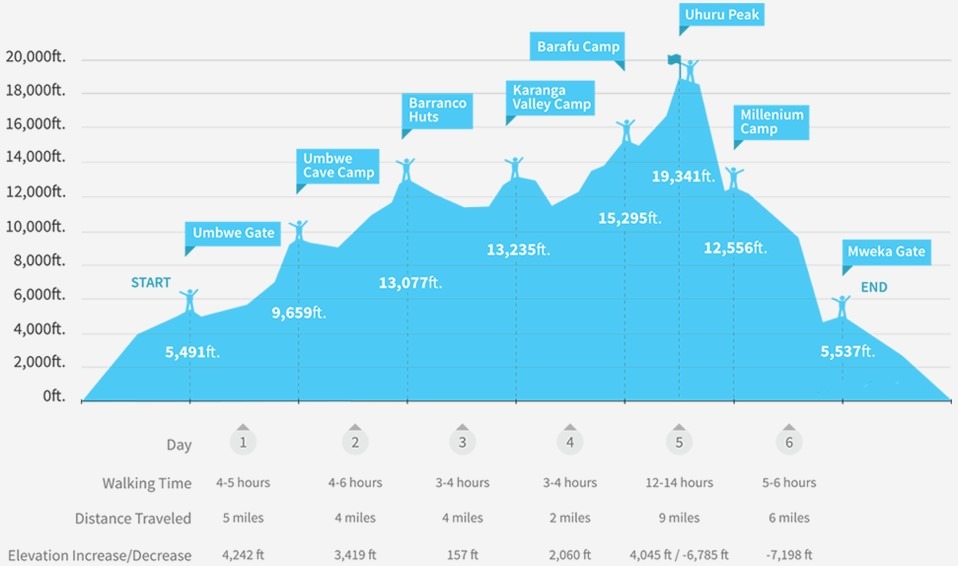
The Umbwe route
The Umbwe route, with 33 miles of distance covered, is one of the shortest and steepest routes to the highest point in all of Africa. This means you better be pre-acclimatized if you are going to go for the challenge. We should point out that this doesn’t means Umbwe is a technical route, it is still just one long walk, however that walk is super steep. If you decide to reach the summit via Western Breach, things just got steeper, because you will gain altitude like nobody’s business. With this kind of opening description, you can understand that not very many climbers opt for this route. They say only about 200 climbers attempt this route a year compared to tens of thousands on the likes of the Machame and Marangu routes. The rewards this route offers apart from extreme joy of overcoming a big physical challenge, is major bragging rights once you get home!
Choose this route if you:
Want the ultimate challenge
Have experience with high altitude
Can consistently climb over steep slopes
Difficulty: Most Difficult
Distance: 33miles (53km)
Style: Camping
Duration: 6-7 Days
The Rongai route
The Rongai route has you start climbing from the northeastern side of the mountain (near the Kenyan Border). The really amazing thing about Rongai route is that it rises above the Amboseli plains and there are really no words to capture how amazing the Amboseli is, you’ll just have to see it for yourself! No other route starts on the northern face of the mountain, so that’s one factoid that’ll set you apart from all the others. Looking for some alone time with nature? Then this is your route, no where near the foot traffic you see on Machame or Marangu, means you’ll have peace and quiet. The only other thing to point out is that the route doesn’t offer a “climb high, sleep low” typography (which is really helpful to acclimatize). Again if you’ve been training hard and are experienced, don’t have any doubts about the Rongai route becauuse it will get you to Uhuru Peak!
Choose this route if you:
Prefer a secluded climb
Want to increase your chances of seeing wildlife
Want to see the view from the north
Difficulty: Moderate
Distance: 45 miles (73km)
Style: Camping
Duration: 6-7 Days
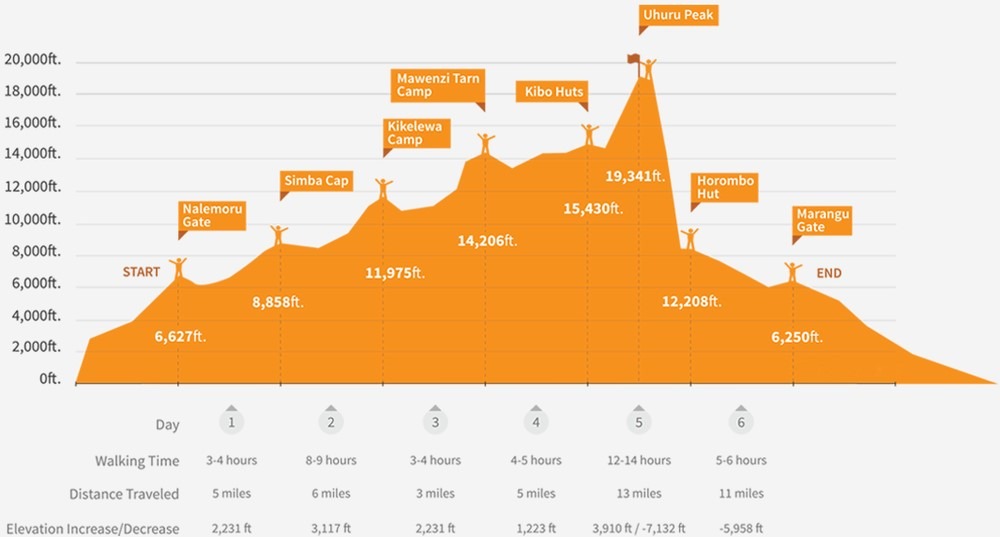
The Northern Circuit Route, the name of this path does have a nice ring to it and if you like to travel off the beaten path then this is the way to go. It’s one of the least used routes and so if quiet is your thing then that is another reason to choose the Northern Circuit. As one of the longest routes up to Uhuru Peak, covering 56 miles, the Northern Circuit basically gives you the opportunity to traverse nearly the entire mountain. No other route offers this kind of tour of Kilimanjaro and therfore is an experience on its own. At a minimum you’ll need 8 days to take the Northern Circuit route, but as many will agree, the more time spent on the mountain the higher your chances of success.
Choose this route if you:
Prefer to be alone with mountain
Want to take longest path up
Can deal with 8 or more day of camping
Difficulty: Moderate
Distance: 56 miles (90km)
Style: Camping
Duration: 8-9 Days
Shira route
Shira route starts high! Yes, you’ll be driven to Shira Gate and at the end of day 1 you will be sleeping above 10,000 feet. This means you should be well acclimatized or have experience with high altitude, as this is a steep change in altitude from your previous night in Moshi or Arusha. Similar to the Lemosho Route, the Shira Route has you kick off your climb from the west and offers some killer views as you cross the Shira Plateau. Once you cross the Shira Plateau the route actually joins up with the Machame Route. In short, Shira offers you peace and quiet with the mountain before you join other fellow trekkers for your final rally to Uhuru Peak.
Choose this route if you:
Can quickly adapt to high altitude
Want a mix between low and high foot traffic
Are excited to cross the Shira Plateau
Difficulty: Difficult
Distance: 35 miles (56km)
Style: Camping
Duration: 7-8 Days
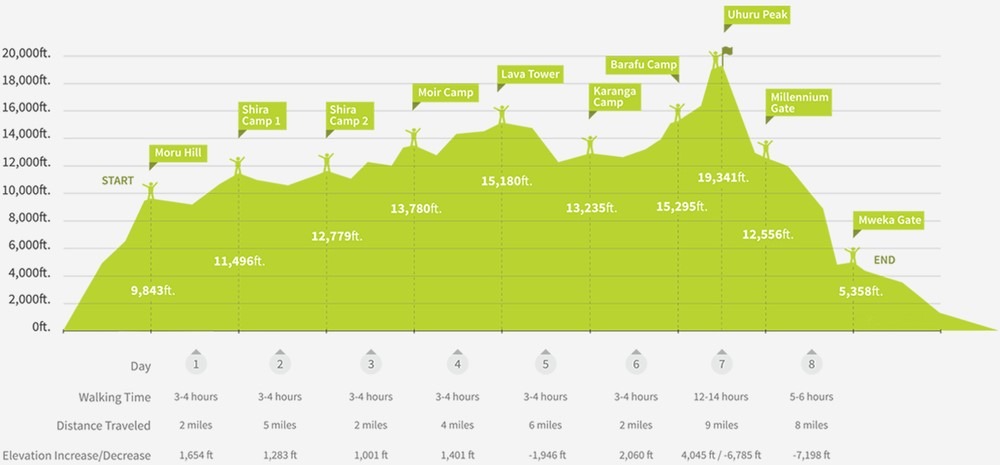
The Machame Route
Choose this route if you:
Want to climb high & sleep low
Want a balanced challenge
Dont mind foot traffic
Difficulty: Difficult
Distance: 39 miles (62 km)
Style: Camping
Duration: 6-7 Days
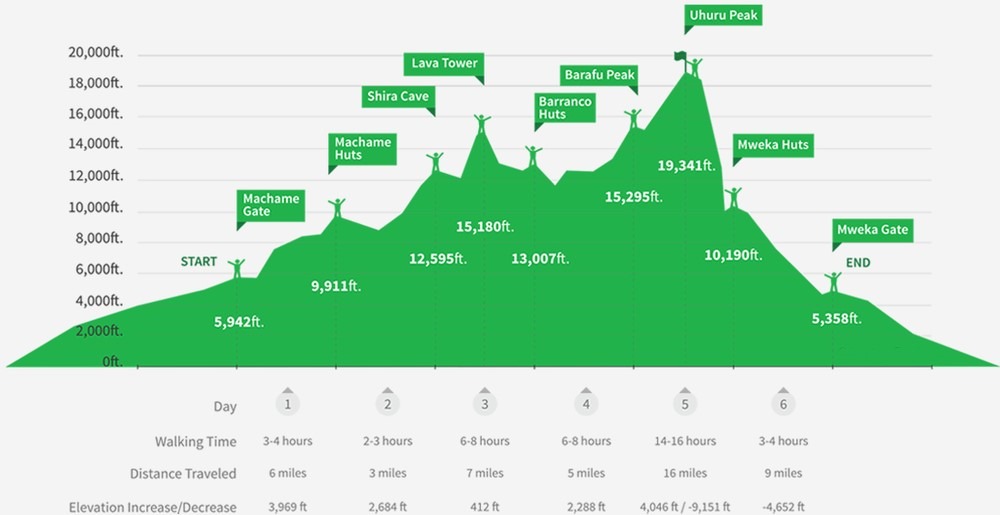
The Lemosho Route has some killer views of West Kilimanjaro and given it starts with a minimum itinerary of 7 days and 6 nights on the mountain – the odds of you making it to Uhuru Peak just got better. If you are into wildlife then this is your route as well, because buffalo, elephants and other wildlife inhabit the Lemosho Glades. The route actually joins up with the Machame Route once you reach Shira Camp 2, so you technically get the best of both words! In summary Lemosho has some incredible scenery, it has low foot traffic and it holds an impressive record on getting trekkers to Uhuru Peak. If you’ve got one week to live life on the edge then Lemosho is probably one of your best choices to climb up Kilimanjaro.
Choose this route if you:
Want to see wildlife
Prefer a secluded time
Have at least 7 days to climb
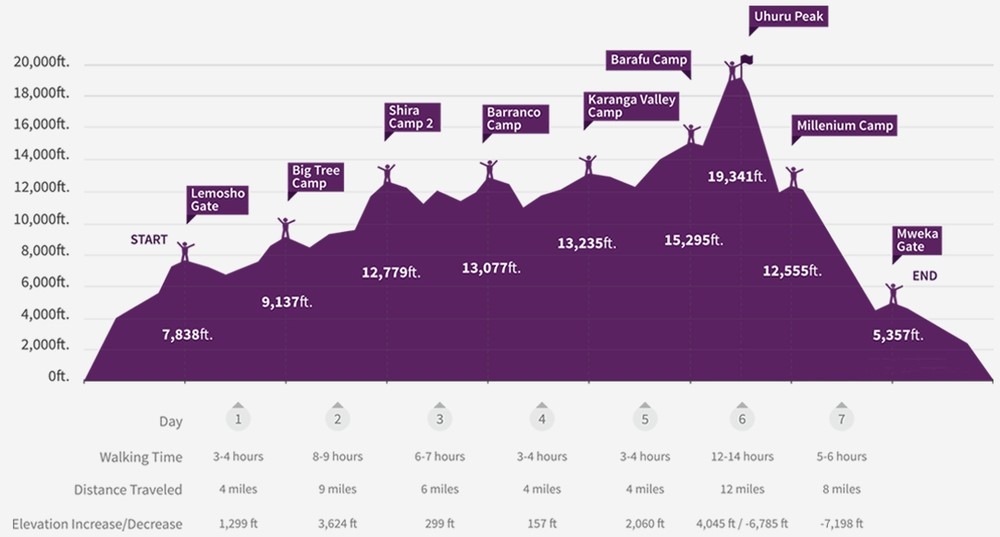
Difficulty: Difficult
Distance: 44 miles (70km)
Style: Camping
Duration: 7-8 Days
Climbing Kilimanjaro is without doubt the biggest draw for most trekkers and walkers. It is an undertaking and not be taken lightly. It is not technically difficult and exceptionally accessible. To most people it is just a trek but please do not underestimate the enormity of taking your body to altitude.
Would be summiteers fail to reach Uhuru Peak (the TRUE summit) because they have not allowed sufficient time to acclimatise.
The most popular ascent route is the Marangu Route (affectionately know as the coca cola route) and the ‘standard’ time for the ascent is to reach the summit is three days. If you were considering such an ascent in any other mountainous region of the world you would not dream of reaching such a height in this number of days.
There are two main reasons for this fast ascent, 1) financial 2) because it is so accessible. We do not think either of the above reasons justify risking your health, safety or enjoyment and do not usually suggest the Marangu Route, preferring to use one of the other routes on Kili. Our mountain team are a dedicated highly trained and extremely professional group. Coming from a climbing and mountaineering background. Our choice of personnel in Tanzania is our top most priority.
Frequently Asked Questions
What are the seven routes to climb Mount Kilimanjaro?
There are seven main routes used to climb Mount Kilimanjaro, and each offers a different experience. These routes are Marangu, Machame, Lemosho, Shira, Rongai, Umbwe, and the Northern Circuit. Some approach from the south, while Rongai comes from the north near the Kenyan border. Each route varies in scenery, difficulty, and duration. Choosing the right one depends on your fitness, experience, and how much time you have.
Which Kilimanjaro route is the easiest?
The Marangu Route is often considered the easiest way to climb Mount Kilimanjaro. It has a more gradual slope and is the only route with hut accommodation instead of camping. This makes it more comfortable, especially for first, time trekkers. However, it is shorter, which can make acclimatization harder. Even though it is called easier, it still requires preparation and determination.
Which route has the highest success rate?
Routes like Lemosho and the Northern Circuit are known for having higher success rates on Mount Kilimanjaro. This is mainly because they are longer and allow better acclimatization. Trekkers have more time to adjust to the altitude, which improves their chances of reaching the summit. These routes also follow a “climb high, sleep low” pattern. While they take more days, they are often worth it for a safer and more comfortable climb.
Which route is the most scenic?
Many climbers say the Machame and Lemosho routes are the most scenic on Mount Kilimanjaro. They pass through a variety of landscapes, including rainforest, moorland, and alpine desert. You also get stunning views of features like the Barranco Wall and wide open valleys. The scenery changes almost every day, which keeps the trek exciting. For photographers and nature lovers, these routes are a great choice.
How do I choose the best route for my climb?
Choosing the best route up Mount Kilimanjaro depends on your personal goals and experience level. If you want a quieter trek, routes like Rongai or Northern Circuit are ideal. For a balance of scenery and challenge, Machame or Lemosho are popular choices. Beginners may prefer Marangu for its hut system, while experienced trekkers might enjoy the challenge of Umbwe. It is always a good idea to talk to a professional guide before making your final decision.
Still have questions?
Our local safari experts are happy to help you plan the perfect African safari.