
Table of Contents
Immerse yourself in the most uplifting challenge of your life – climbing Mount Kilimanjaro. Reaching the snow-covered summit of the world’s highest, freestanding mountain means climbing from the tropics to the arctic, through 5 different climatic zones. With routes suitable for the beginner to the experienced climber, you’ll traverse a rainforest, moorland, alpine desert, snowfields and ice cliffs on your expedition to Uhuru Peak.
A Journey to the Roof of the Continent
75,000 people a year climb Kilimanjaro. Each day brings you new landscapes, magical sunrises and sunsets, unfathomable views, and a unique sense of togetherness in camp. Climbing Kili is a profound experience that stays with you forever. It’s an achievable climb for all ages if you are physically fit and determined. If you fail to reach the summit, it’s probably because you didn’t give yourself enough time to acclimatise.
Have you been to Mount Kilimanjaro National Park?
Write A Comment Below
Routes to the Summit, Camaraderie in Camp and Other Highlights
7 Routes to Suit Your Stamina
You can choose from seven routes up the mountain, which all merge onto a circular path at Kibo Crater where you take the final ascent up to the magnificent Uhuru Peak. The paths range in difficulty, scenery and length. Marangu (also known as the ‘Coca-Cola’ route) is the shortest and busiest route up the mountain, taking up to 6 days. Shira, Machame and Lemosho takes a day longer and is considered the most beautiful path, starting in the dense rainforest at Machame gate for Machame and Lemosho Gate for Lemsosho. For a quieter, less-travelled route that lets you acclimatise slowly over 9 days, we recommend Northern Circuit Route. Trekking this steady ascent gives you the best chance of reaching Uhuru peak, and plenty of time to take in the wildlife and contrasting landscapes. Umbwe Route is the most difficult and it needs you to have a mountain hiking experience while Rongai Route is popular during rain season and with less traffic.
Camaraderie in Camp
A friendly crew will accompany you up the mountain – a cook, 8 to 9 porters and a guide with his assistant for 2 trekkers. This experienced camp crew will see to your every need, including providing 3 hot meals a day and lots of drinks and snacks. As darkness falls, camp camaraderie is at it’s best. Imagine sitting around the campfire after a warm meal, sharing the day’s highlights with your group and predicting tomorrow’s undiscovered marvels. With no technology or tasks to distract you, the sense of “togetherness” in camp is great fun and a wonderful experience in itself. Under the shelter of your mountain tent, snuggle down in your thermal sleeping bag and rest those weary feet, because there’s a long day’s climbing ahead of you. Each day brings a new set of challenges and life-long memories.
Climbing from the Tropics to the Arctic
Your adventure begins on Kilimanjaro’s fertile foot slopes, dotted with volcanic springs. Some routes take you through a wonderful rainforest, teeming with blue monkeys, baboons, bush babies, buck and mongoose. You’ll notice the wildlife becoming sparser as the forest thins and gives way to heather-lined moorland where Giant lobelia flourish, their huge flowers attracting scarlet-tufted malachite sunbirds. The landscape then changes to dry, alpine desert and the temperature noticeably drops, although the sun is harsh. The alpine desert has little in the way of wildlife, but it’s thrilling to see bearded vultures riding the bumpy thermals. At about 4,700m, you will spend the night in camp at the bottom of Kibo Crater, acclimatising to the altitude and lower oxygen levels.
Sunrise at Uhuru Peak
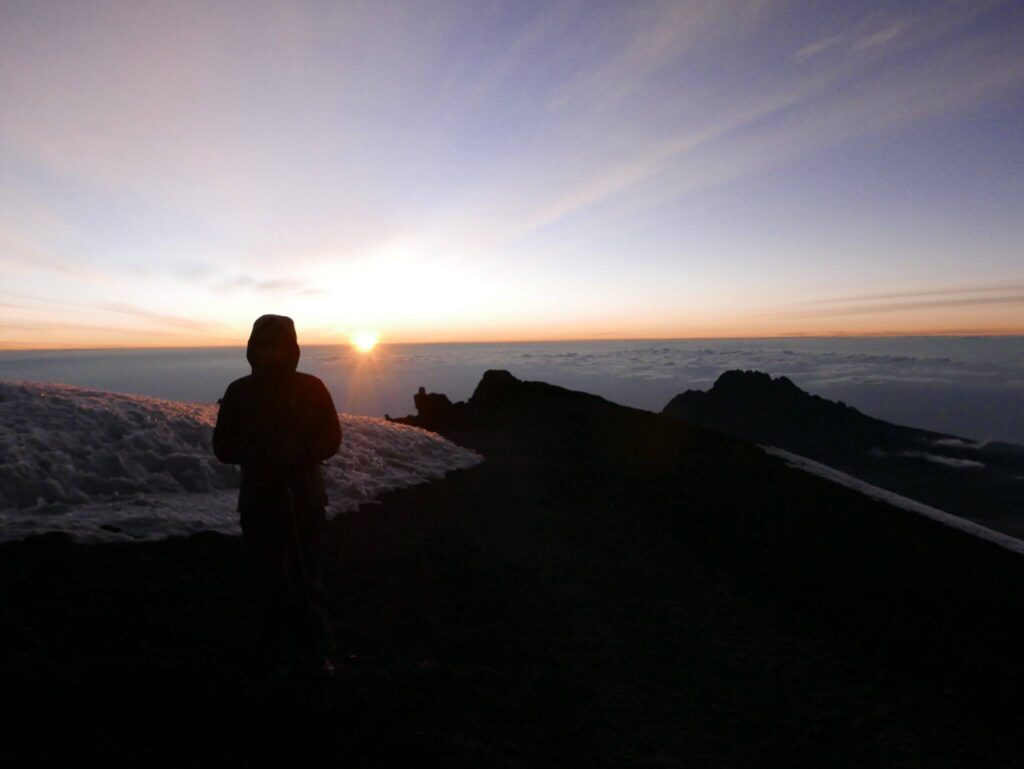
Starting in the early hours, the final leg of the ascent is the most taxing and your guides will be an enormous support in spurring you on. They coordinate the trek perfectly, so that you reach Uhuru Peak in time to witness the most magnificent sunrise over Africa. Have your camera at the ready, because this is a mind-blowing moment. Everyone falls silent, overwhelmed that they are actually standing on the roof of the continent, looking down upon Tanzania’s vast plains towards the Ngorongoro Crater and the Serengeti. If the skies are clear, you can see the lights of Nairobi in Kenya. After your descent, enjoy a well-deserved celebration dinner, medal and certificate!
Activities
Don’t miss out on visiting the waterfalls at Kinukamori and Materuni in the close to the park, or take an outing to the volcanic Lake Chala on the eastern edge, where there is an abundance of wild animals. There are game drives and wildlife tours on certain routes. If you are tired from your climb, why not spend a leisurely few hours on a cultural tour, learning how the Chagga tribe live?
Accommodation
Only the Marangu route has thatched huts, where you’ll sleep in dormitories. On all other routes, accommodation is in mountain tents at designated camp sites. The camp crews are extremely well-experienced and will look after your every need. If you prefer “glamping”, you can hire a luxury tent at extra cost, which has camp beds and a private toilet. Outside Kilimanjaro National Park, there are good hotels in the town of Moshi, campsites in the village of Marangu, and some comfortable lodges not far from the Park.
Best Time to Visit
Give yourself the best chance of a successful climb by choosing the drier, warmer months from June to October. January to mid-March are also dry, but colder, so there will be more snow on your route.

How to Get There
Fly into Kilimanjaro International Airport. Depending on your choice of route up the mountain, you’ll drive 45km to either Moshi town or Arusha town, where you will begin preparations for your climb. Distances and times vary according to which route and gate you choose, and your tour operator will confirm all details.
Frequently Asked Questions
Why is Kilimanjaro National Park considered so unique?
Kilimanjaro National Park is unique because it is home to Mount Kilimanjaro, the tallest mountain in Africa and the highest free, standing mountain in the world. Unlike mountain ranges, Kilimanjaro rises dramatically on its own from the surrounding plains. This makes it one of the most iconic natural landmarks on Earth. The park is also a UNESCO World Heritage Site, recognized for its global importance. Its beauty lies not just in its height, but in how it dominates the landscape. Standing at its base, the sheer scale of the mountain feels almost unreal.
What kind of landscapes can you experience in the park?
One of the most fascinating things about Kilimanjaro is its five distinct ecological zones. You start in lush rainforest filled with monkeys and birds, then move into moorland with giant plants. Higher up, the landscape changes into an alpine desert with very little vegetation. Finally, you reach the icy Arctic summit zone near Uhuru Peak. It feels like traveling from the equator to the North Pole in just a few days. This dramatic shift in scenery is something very few places in the world can offer.
Do you need technical climbing skills to explore Kilimanjaro?
Surprisingly, you don’t need technical mountaineering skills to climb Kilimanjaro. It is often called a “walkable mountain” because most routes involve trekking rather than climbing. However, that doesn’t mean it’s easy, the altitude and long hiking days make it physically demanding. Proper acclimatization is key to success. Many people reach the summit with the help of experienced guides and porters. With determination and preparation, it’s achievable for many adventurous travelers.
What kind of wildlife lives in Kilimanjaro National Park?
Although Kilimanjaro is famous for trekking, it also supports a variety of wildlife, especially in the lower forest zones. You might spot animals like elephants, buffalo, colobus monkeys, and even leopards, though they are rare. The park is also home to many bird species, making it great for birdwatching. As you climb higher, wildlife becomes less common due to the harsh conditions. Still, the biodiversity at lower elevations adds an extra layer to the experience. It’s a unique mix of safari and mountain adventure.
How does Kilimanjaro compare to other famous mountains?
Kilimanjaro stands out because it combines accessibility with extreme altitude. Compared to Mount Kenya, which requires technical climbing for its highest peaks, Kilimanjaro is more accessible to non, climbers. It also differs from mountains like the Himalayas, which often require advanced skills and longer expeditions. Another unique aspect is its location near the equator, yet it still has glaciers at the summit. This contrast of tropical and Arctic environments is rare. It’s truly a one, of, a, kind destination that attracts adventurers from all over the world.
Still have questions?
Our local safari experts are happy to help you plan the perfect African safari.


